The Hollowmarked
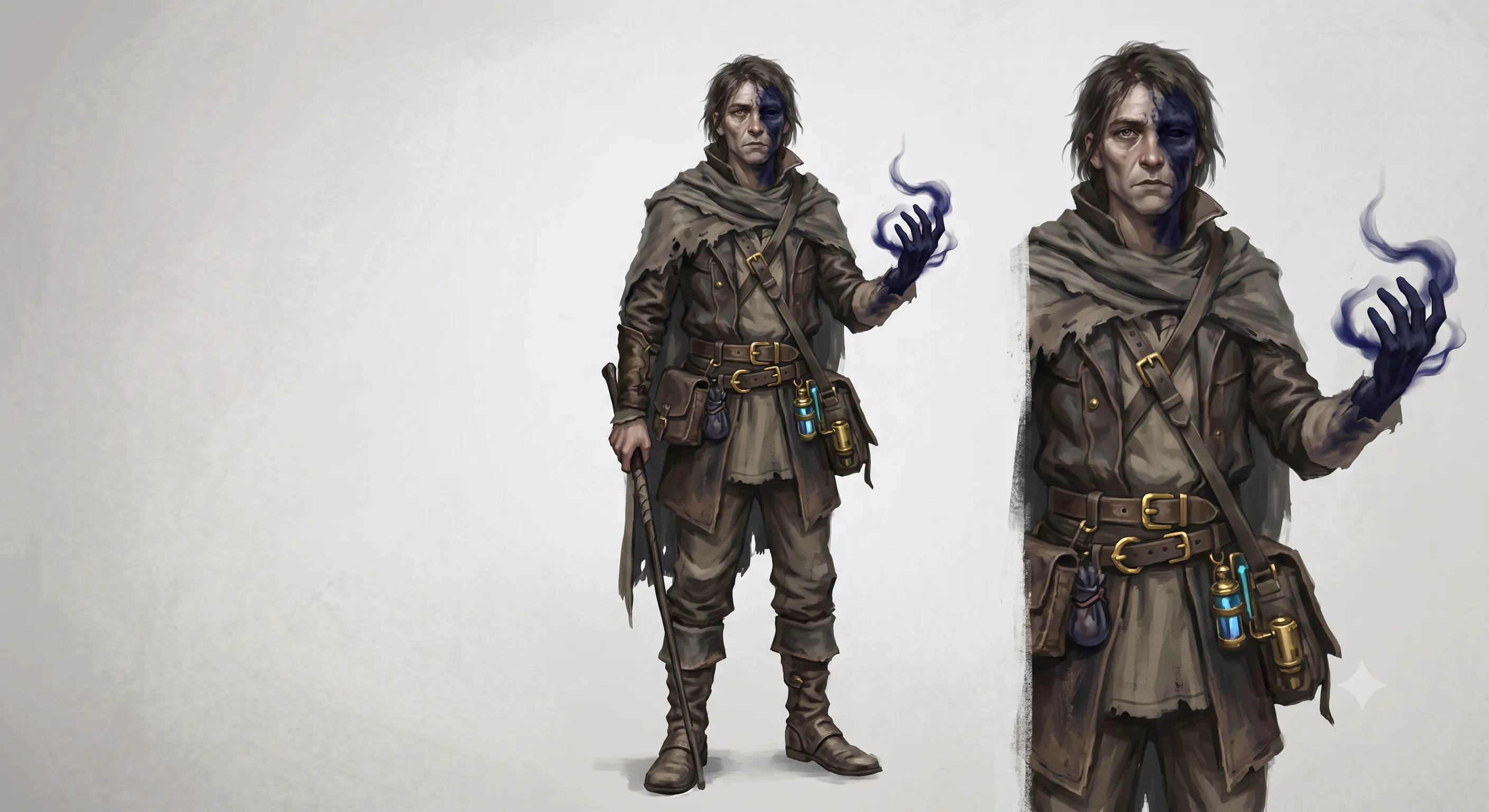
Plays like: the Monk’s rhythm — a die you learn to spend and dread — on an armored threshold-guard. Expect a wary occult sentinel, not a fast unarmored flurry; your power is knowing where the world is thin.
The Hollowmarked is someone the Wound touched — and let go. Where it brushed them, a scar remains: not a wound that heals, but a door that never quite latches, indigo-black at the edges, faintly warm to the touch on cold nights. They are not Hollow-casters — no one is, lawfully, and the Hollowmarked least of all, because they alone know exactly what stands on the other side of that door and have spent every day since making sure it stays shut. What legitimate power they carry, they draw the honest way: a hard-won half-Reaching into the Dream, the one discipline that borders the Hollow closely enough to make sense of what happened to them, and no closer. The rest of what they carry is a body that has learned, the hard way, to fight standing on a threshold.
“I didn’t come back whole. I came back with a door in me, and I have spent every day since learning how to guard it. Some nights it’s heavier than others. Tonight it’s very heavy. Stand behind me.”
Quick Build & Core Stats
Section titled “Quick Build & Core Stats”Quick Build: High Wisdom (your instinct is the only warning you get), then Constitution (you take a scar’s toll every day you’re upright), then Dexterity or Strength depending on how you fight. Choose the Wound-Warden if you want the party’s shield against the uncanny; the Dreamwalker for a scout and threshold-crosser; the Fraying only if you and your table want the horror to be genuinely close.
- Hit Die: d8 (d8 + Con mod per level after 1st)
- Primary Ability: Wisdom
- Saving Throws: Constitution, Wisdom
- Armor: Light and medium armor, shields
- Weapons: Simple weapons
- Tools: One musical instrument or herbalism kit (the trance-tools of a threshold-watcher)
- Skills: Choose 4: Insight, Perception, Survival, Medicine, Arcana, Religion, Intimidation, Investigation
- Starting Equipment: A simple weapon and a shield, or two simple weapons; light or medium armor; a Focus Stone (yours never fully clears — a hairline of black runs through it always, and no jeweler has explained why); a healer’s kit; a bedroll marked with a ward you drew yourself, badly, the first week after you survived
The Hollowmarked Table
Section titled “The Hollowmarked Table”| Level | Proficiency Bonus | Features | Wound Die | Max Working Tier (the Dream) |
|---|---|---|---|---|
| 1 | +2 | Hollowmark; Wound Die (1 Edge-Surge known); Instinct of the Marked; Fighting Style | d4 | — |
| 2 | +2 | Reaching: The Dream; Settle the Mark; 2nd Edge-Surge known | d4 | 1 |
| 3 | +2 | Vigil chosen; Vigil feature | d4 | 1 |
| 4 | +2 | Ability Score Improvement | d4 | 1 |
| 5 | +3 | Extra Attack; 3rd Edge-Surge known | d4 | 2 |
| 6 | +3 | Vigil feature | d4 | 2 |
| 7 | +3 | Ward the Threshold | d6 | 2 |
| 8 | +3 | Ability Score Improvement | d6 | 2 |
| 9 | +4 | Tier 3 access; 4th Edge-Surge known | d6 | 3 |
| 10 | +4 | Vigil feature | d6 | 3 |
| 11 | +4 | Deepened Mark | d6 | 3 |
| 12 | +4 | Ability Score Improvement | d6 | 3 |
| 13 | +5 | Edge of Waking | d8 | 4 |
| 14 | +5 | Vigil feature | d8 | 4 |
| 15 | +5 | Unshakeable Scar | d8 | 4 |
| 16 | +5 | Ability Score Improvement | d8 | 4 |
| 17 | +6 | 5th Edge-Surge known; Mark Mastery | d10 | 4 |
| 18 | +6 | Between Two Worlds | d10 | 4 |
| 19 | +6 | Ability Score Improvement | d10 | 4 |
| 20 | +6 | The Sealed Door (capstone) | d10 | 4 |
“Wound Die” is your starting die each long rest — see below for how it grows in play. “Max Working Tier” follows the standard half-Reaching curve: Tier 1 at 2nd, Tier 2 at 5th, Tier 3 at 9th, Tier 4 at 13th, holding at Tier 4 through 20th.
Class Features
Section titled “Class Features”Hollowmark. At character creation, describe where the Wound touched you and what your mark looks like — a stain along the collarbone, a hairline crack across an iris, a patch of skin that no longer takes sunburn. It is always visible in some way when you look for it, and sometimes when you don’t. This is not a spell effect and can’t be dispelled; it is simply what happened to you.
Wound Die (signature resource). Your mark is a doorway you keep barely shut, and you can lean on it. As a bonus action, you may Draw on the Wound to fuel one Edge-Surge you know (see the list below — you know 1 at 1st level, and gain an additional Surge known at 2nd, 5th, 9th, and 17th). Roll your current Wound Die and apply the result to the Surge’s effect.
Edge-Surges are not Workings, and not magic you shape — they are instinct, the reflexes and dread-sharpened senses a body learns standing on a threshold no one else has survived. They cost no Fray and no Strain, your eyes do not flash a discipline’s color, and their whole price is the escalating personal risk of the Wound Die itself (below). The exceptions are the two Surges that reach past instinct and actually part the door a crack — Steady the Living (mending) and, at Path tier, Exorcist’s Hand (banishing). Those are genuine flickers of the Dream, and they cost 1 Fray each in addition to the Draw. Even the marked cannot bleed the Dream into the world for free.
Immediately after you resolve a Draw, your Wound Die steps up one size (d4→d6→d8→d10→d12) for the rest of the day — the mark wakes further each time you use it. You may Draw a number of times per long rest equal to your proficiency bonus for free; you may keep Drawing past that limit, but every Draw beyond it automatically triggers a Mark Spread check (below), no roll required to trigger it.
If you Draw while your die is already a d12, roll an additional d20 immediately after: on a 1–5, your mark spreads — check one box on your five-box Mark track (see below). Your Wound Die resets to d4 at the start of a long rest; the Mark track does not clear with rest and can only be worked down through genuine in-fiction downtime — a ward-rite, a healer who specializes in the marked, a season of quiet (GM’s call).
Edge-Surges (choose from as known):
- See the Void’s Edge — reaction, when you or a creature within 30 feet is targeted by a fear, illusion, or Dream-/Hollow-adjacent effect: add your Wound Die roll to that creature’s save, or grant it advantage if it doesn’t normally save.
- Steady the Living — action, +1 Fray (a true flicker of the Dream): touch a creature: it regains hit points equal to your Wound Die roll + your Wisdom modifier.
- Read What Shouldn’t Be Read — action, study a creature or place touched by the uncanny: learn one true fact about it the GM chooses from what’s knowable, DC set by your Wound Die roll vs. the GM’s threshold.
- Borrow a Flash of the Impossible — action, gain advantage on your next attack roll, ability check, or saving throw before the end of your next turn; if your Wound Die rolls its maximum, gain advantage on all three instead.
- Push Back the Dark — action, a Hollow-touched or Dream-native creature within 30 feet must succeed a Wisdom save (DC 8 + proficiency bonus + Wisdom modifier) or be pushed 15 feet away and treat the area around you as difficult terrain until the end of your next turn.
- Thin-World Strike — no action, when you hit a creature with a weapon attack: Draw and add your Wound Die roll to the damage, and the target must succeed a Constitution save (DC 8 + proficiency bonus + Wisdom modifier) or be staggered — it can’t take reactions and its speed is halved — until the end of its next turn. You didn’t hit harder. You hit where the world is thin, and for one breath the target is standing on your threshold instead of theirs.
Instinct of the Marked. You have advantage on Wisdom (Perception) and Wisdom (Insight) checks made to notice or read anything touched by the Dream or the Hollow — a lie, an omen, a manifestation, a fellow marked soul. You can never be surprised by a Hollow-touched creature.
Fighting Style. Choose one: Defense (+1 AC while wearing armor), Dueling (+2 damage with a one-handed weapon and nothing in your other hand), or Protection (with a shield, impose disadvantage on an attack against an ally within 5 feet, reaction).
Reaching: The Dream 2nd You gain a half-Reaching into the Dream — indigo, Chaos, the one discipline that architecturally borders the Hollow, which is exactly why you can walk it and almost no one else can. You know a number of Dream Workings equal to 1 + your Wisdom modifier (minimum 1), up to your Max Working Tier; you may swap one known Working whenever you gain a level. Casting spends Fray as normal — rolled against your Faith Die, never clearing on a short rest, a long rest of genuine stillness healing half. Your eyes flash indigo on every cast, but watchers who succeed the Insight check to read you also notice the single fleck of black at the center of the flash — proof, if they know to look, of exactly what you survived. Casting above base Tier requires your Focus Stone.
Settle the Mark 2nd When you finish a short rest, choose one: regain one expended free Draw, or step your Wound Die down one size (minimum d4). A watch is kept in shifts, not held in one white-knuckled grip — the marked who lean on the door and then breathe last longer than the ones who hoard the leaning for a worse night that never quite comes.
Extra Attack 5th You can attack twice, instead of once, whenever you take the Attack action on your turn. This is not flourish; it is drill. A guard who cannot end a fight quickly is a door left standing open.
Ward the Threshold 7th As a reaction, when a creature within 30 feet would take damage or suffer an effect from a Hollow-touched or Dream-based source, you may Draw on the Wound to grant them resistance to that damage, or advantage on the triggering save.
Deepened Mark 11th Once per long rest, when you would step your Wound Die up past d12 (i.e., you Draw while already at d12), you may instead hold it at d12 for that single Draw with no die-size change and no immediate spread check — the door creaks, but doesn’t move.
Edge of Waking 13th Once per long rest, you may Draw on the Wound with automatic success on the effect’s numeric component (treat your roll as the maximum of your current die) with no Mark Spread check, regardless of your die size.
Unshakeable Scar 15th You have resistance to psychic damage, and advantage on all saving throws against being frightened, charmed, or possessed. Additionally, your Mark Spread check threshold at d12 drops from 1–5 to a flat 1 — your scar has learned, mostly, how to hold.
Mark Mastery 17th Once per long rest, you may Draw on the Wound without stepping your die up afterward, as if the mark simply hadn’t noticed.
Between Two Worlds 18th Once per long rest, as an action, you may see the Dream layered faintly over reality for 1 minute: you see invisible Dream-native and Hollow-touched creatures, and you and allies within 30 feet have advantage on Insight and Perception checks against illusions for the duration.
The Sealed Door (20th, capstone). Once per long rest, as a reaction to a killing blow, a Hollow-touched horror, or an Unraveling-scale threat, you may slam the door on your own scar. For 1 minute: you are immune to fear, charm, possession, and any effect originating from the Hollow or the Dream; you have resistance to all damage from such sources; and your Wound Die and Mark track are frozen — no Draws, no spread, nothing gets in or out. When the minute ends, your Wound Die resets to d4 and you may immediately take one free Draw treating your die as a d12 with no Mark Spread check, as the door swings back open on its own. You have stood on this threshold before. You know exactly how to shut it, for a moment — and exactly what it costs when it opens again.
The Three Vigils
Section titled “The Three Vigils”A Hollowmarked’s Path is their Vigil — the watch they keep over what happened to them, chosen at 3rd level.
The Dreamwalker Vigil — threshold-crosser, dream-seer
Section titled “The Dreamwalker Vigil — threshold-crosser, dream-seer”3rd — Threshold Sight. You may enter a light trance during a short rest to ask your GM one question about a recent dream, omen, or portent relevant to the current situation; you also have advantage on Insight and Investigation checks involving dreams and the unconscious. 6th — Step Between. As an action, spend a Draw on the Wound to briefly cross into the Dream and reappear anywhere you can picture within 30 feet, unseen for the moment of transit. 10th — Dreamer’s Court. Once per long rest, put a willing creature into a deep trance for up to 1 hour and enter it alongside them, walking their subconscious as a shared, safe scene (GM adjudicates content and outcome). 14th — Walker of Both Roads. You may cast any Dream Working you know as though you were standing partly inside the Dreamscape, extending its range, duration, or targets by roughly one step (GM’s discretion) at no additional cost. Once per long rest, you may sense the location of anyone whose dream you have personally walked, anywhere on the same plane.
The Wound-Warden Vigil — hunts what the Hollow leaves behind, shields the living
Section titled “The Wound-Warden Vigil — hunts what the Hollow leaves behind, shields the living”3rd — Warden’s Eye. You automatically sense Hollow-touched creatures and effects within 60 feet, no action required, and have advantage on checks to identify or classify them. 6th — Shield the Living. As a reaction, spend a Draw on the Wound to grant a creature within 30 feet resistance to damage from, or advantage on a save against, a Hollow-touched or Dream-based source — this Draw doesn’t require your Ward the Threshold trigger to line up first; it’s always available. 10th — Bulwark of the Mark. You gain resistance to psychic damage and advantage on saves against fear, charm, and possession at all times (this stacks with, and is redundant with, Unshakeable Scar at higher level — you simply get it early). When you Draw on the Wound specifically to protect another creature, your die does not step up. 14th — Exorcist’s Hand. As an action, spend a Draw on the Wound (+1 Fray, a true parting of the door) and touch a Hollow-manifestation or Hollow-touched creature; it must succeed a Wisdom save (your Working save DC) or be forced back, suppressed, or banished for 1 minute, scale set by the GM to the fiction. This specific Draw never risks Mark Spread, regardless of your die size.
The Fraying Vigil — walks closest to the edge
Section titled “The Fraying Vigil — walks closest to the edge”3rd — Open Vein. You may Draw on the Wound as a free action once per turn (instead of a bonus action), and your numeric Edge-Surges add your proficiency bonus on top of the die roll. 6th — Hungry Scar. When you Draw on the Wound, you may choose to skip the normal die-step-up and instead immediately roll the Mark Spread check regardless of your current die size — trading a slower burn for an earlier, cheaper risk. 10th — Feed the Edge. Once per turn, when you reduce a creature to 0 hit points or land a critical hit, you may immediately reset your Wound Die to d4 without waiting for a long rest. The mark quiets — but you, and anyone who knows you, notice it doesn’t quite look the same afterward. 14th — Willing Sacrifice. Once per long rest, you may voluntarily check one box on your Mark track — no roll, your choice — to treat your next three Draws this scene as though your die were a d12, with no further die-size change and no Mark Spread checks from those three Draws.