The Duelist
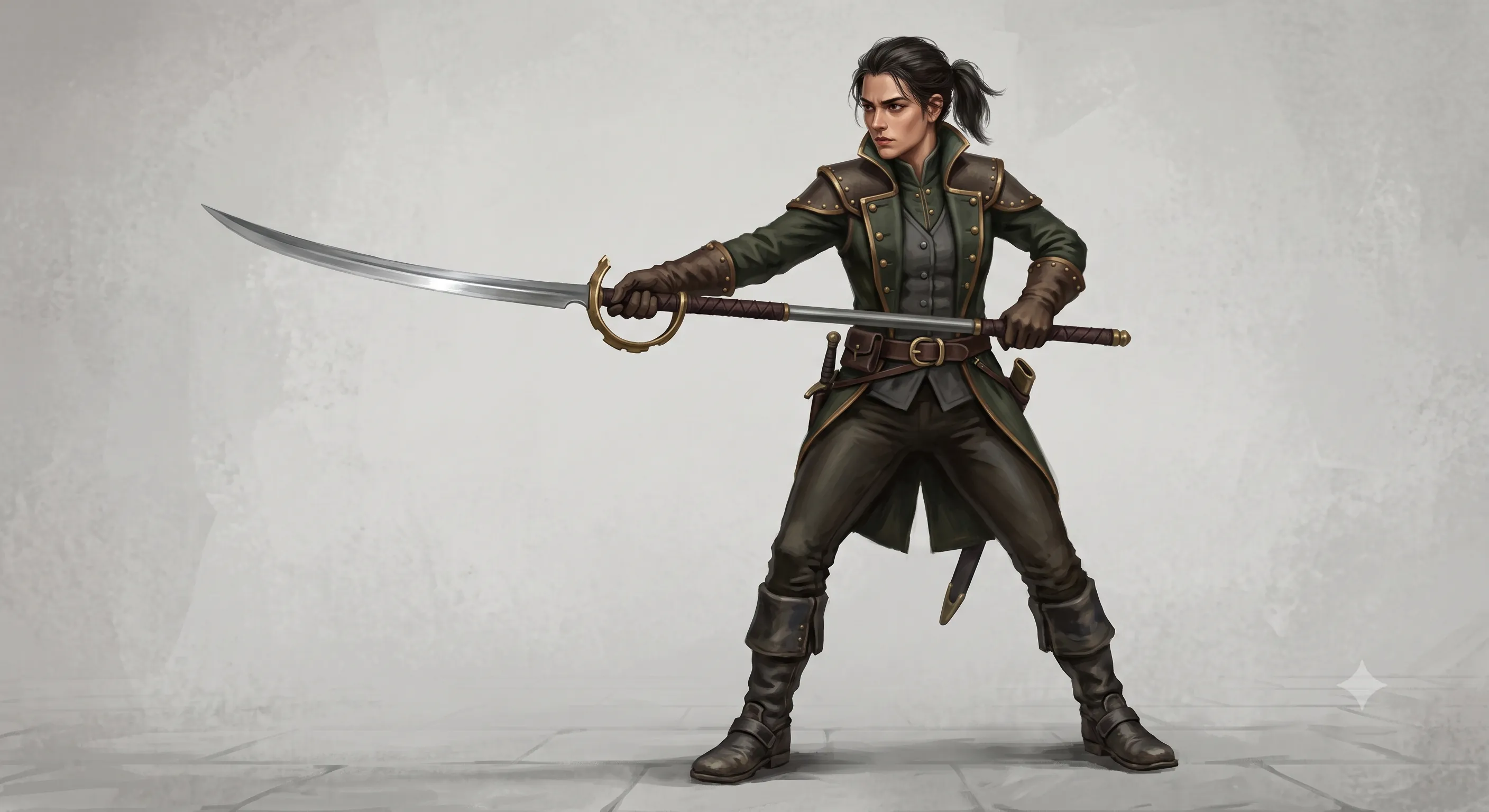
Plays like: the Fighter (Battle Master) — a pure blademaster; no magic, all skill.
Identity: The Duelist is proof that a sword needs no Reaching to be terrifying. Where Order-casters bind the world and Chaos-casters bleed themselves for it, the Duelist has spent a lifetime turning footwork, timing, and steel into a language all its own — flowing between fighting Forms the way a caster flows between disciplines, spending nothing but skill. No Strain, no Fray, no flashing eyes: just a blade that is always exactly where it needs to be.
“You keep asking what discipline I hold. None. I hold the line, the guard, the opening — and I never miss it twice.” — Sael Adrenne, blade-mistress of the Precise Line
Quick Build & Core Stats
Section titled “Quick Build & Core Stats”Quick build: High Dexterity, then Constitution; pick the Dueling fighting style and the Precise Line path for a classic riposte-and-rapier duelist, or Two-Weapon Fighting and Storm-of-Steel to come out swinging, or the Archery style and the Long Watch to hold the field from range.
- Hit Die: d10
- Primary Ability: Strength or Dexterity (finesse)
- Saving Throws: Dexterity, Constitution
- Armor: Light and medium armor, shields
- Weapons: Simple weapons, martial weapons
- Skills: Choose 3 — Acrobatics, Athletics, Insight, Intimidation, Perception, Persuasion, Sleight of Hand, Stealth
- Starting Equipment: A rapier or shortsword; a second finesse weapon, a shield, or a shortbow and 20 arrows; leather armor; two daggers; an explorer’s pack; unshaped Faith like any soul in Merretia — no Reaching required to lend it.
Many duelists eventually have a bonded focus stone set into their signature blade — the stone remembers the shape so they don’t have to Reach (see Chapter 9, Stone-Set Gear).
The Duelist — Level Table
Section titled “The Duelist — Level Table”| Level | Prof. Bonus | Features | Form Points |
|---|---|---|---|
| 1 | +2 | Fighting Style, Forms, Maneuvers (3 known) | 2 |
| 2 | +2 | Second Wind, Perfect Tempo | 2 |
| 3 | +2 | Path chosen | 3 |
| 4 | +2 | Ability Score Improvement | 3 |
| 5 | +3 | Extra Attack | 4 |
| 6 | +3 | Ability Score Improvement | 4 |
| 7 | +3 | Maneuvers Known (4), Path feature | 5 |
| 8 | +3 | Ability Score Improvement | 5 |
| 9 | +4 | Uncanny Parry, Iron Composure | 6 |
| 10 | +4 | Path feature | 6 |
| 11 | +4 | Extra Attack (2), Flowing Forms | 7 |
| 12 | +4 | Ability Score Improvement | 7 |
| 13 | +5 | Maneuvers Known (5), maneuver die d8 | 8 |
| 14 | +5 | Ability Score Improvement | 8 |
| 15 | +5 | Relentless Blade, Path feature | 9 |
| 16 | +5 | Ability Score Improvement | 9 |
| 17 | +6 | Maneuvers Known (6), maneuver die d10 | 10 |
| 18 | +6 | Blade Sense, Path feature | 10 |
| 19 | +6 | Ability Score Improvement | 11 |
| 20 | +6 | Master of the Blade | 12 |
Class Features
Section titled “Class Features”Fighting Style. At 1st level, choose one (see Chapter 2): Dueling (+2 damage when wielding a melee weapon in one hand and nothing in the other), Two-Weapon Fighting (add your ability modifier to the damage of your off-hand attack), Archery (+2 bonus to attack rolls you make with ranged weapons), Defense (+1 AC while you wear armor), or Blind Fighting (blindsight to 10 feet — you can see anything within that range that isn’t behind total cover, even while blinded or in darkness).
Forms. You know three base Forms and may switch between them freely as a bonus action (once per turn), holding one at a time:
- Guard Form — +2 AC.
- Aggressor Form — +2 to damage rolls with finesse or light weapons, −2 AC.
- Evasive Form — +10 ft. speed; you can Disengage as a bonus action; advantage on Dexterity saves against being knocked prone or restrained.
Form Points & Maneuvers. Your maneuver die starts at d6 (d8 at 13th, d10 at 17th). You spend 1 Form Point to fuel a maneuver (unless noted otherwise); Form Points fully recover on a short or long rest, mirroring the body’s short recovery of Strain. You know 3 maneuvers at 1st level (4th at 7th, 5th at 13th, 6th at 17th), chosen from:
- Riposte (reaction) — When a creature you can see hits you with a melee attack, spend 1 FP to make a melee attack against it; on a hit, add your maneuver die to the damage.
- Disarming Strike (on hit) — Spend 1 FP; the target makes a Strength save (DC 8 + prof. + Str/Dex mod) or drops one item; add maneuver die to damage.
- Precise Strike (before/after a roll) — Spend 1 FP to add your maneuver die to an attack roll.
- Feint (bonus action) — Spend 1 FP; your next attack against a creature within 5 ft. before the end of your next turn has advantage.
- Footwork (part of your move) — Spend 1 FP to move up to your speed without provoking opportunity attacks.
- Trip Attack (on hit) — Spend 1 FP; target makes a Strength save or falls prone; add maneuver die to damage.
- Goading Strike (on hit) — Spend 1 FP; target has disadvantage on attacks against anyone but you until the start of your next turn.
Second Wind (2nd) — Bonus action, once per short rest: regain 1d10 + Duelist level HP.
Perfect Tempo (2nd) — Once per short rest, you find the beat between your opponent’s heartbeats: take one additional action on your turn.
Extra Attack (5th, 11th) — Attack twice when you take the Attack action; three times at 11th.
Uncanny Parry (9th) — Reaction, no cost: when hit by an attack, halve the damage.
Iron Composure (9th) — The discipline that steadies a blade steadies everything else. When you fail a saving throw, you can spend 2 Form Points to reroll it; you must use the new roll. Once per round.
Flowing Forms (11th) — Once per turn, you can switch Forms without spending your bonus action; the change simply happens between one step and the next.
Relentless Blade (15th) — Regain 1 Form Point when you score a critical hit or reduce a creature to 0 HP.
Blade Sense (18th) — Advantage on initiative; you can’t be surprised while conscious.
Master of the Blade (20th, capstone) — The language of the blade has no more words to teach you. Once per turn when you hit with a weapon attack, use a maneuver for free (no FP cost) — every turn, no limit. While you are in a Form, you attack four times, instead of three, when you take the Attack action (eight on a Perfect Tempo turn, if your arm holds). You may also take a second reaction each round once per long rest.
The Four Paths — Schools of the Blade
Section titled “The Four Paths — Schools of the Blade”At 3rd level you commit to a Path — a school of the blade that shapes how you spend Form Points and where your discipline bites hardest. Your Path grants features at 3rd, 7th, 10th, 15th, and 18th level. Three of the four Paths below are schools of close steel; the fourth, the Long Watch, is the marksman’s road — proof that a Duelist’s timing reaches as far as an arrow flies. Where a Path feature calls for a saving throw, the DC is 8 + your proficiency bonus + your Strength or Dexterity modifier (whichever you use for the weapon attacks that fuel your maneuvers) unless the feature names a specific ability.
The Precise Line — the counterpuncher
Section titled “The Precise Line — the counterpuncher”Counterpunch and precision: wait for the opening, and never miss it twice. The Precise Line duelist wins by making the enemy’s own attack the mistake that kills them — every parry is a question, and every riposte is the answer.
3rd — Opening Guard. Your Guard Form is tighter than anyone else’s: while you hold it, it grants +3 AC instead of +2. And your patience is rewarded the instant the fight begins — the first Riposte you make in each combat costs no Form Points (you still spend your reaction as normal). Every fight opens with one free answer already in the chamber.
7th — Answering Steel. Your counterstrike carries you into the gap the enemy just left open. When your Riposte hits, you may immediately move up to 5 feet as part of that same reaction, without provoking opportunity attacks. If the Riposte was a critical hit or reduced the target to 0 hit points, you may move up to 10 feet instead — stepping cleanly into the next line before the body has finished falling.
10th — Perfect Parry. You punish the miss as surely as the hit. When a creature you can see misses you with a melee attack while you are in Guard Form, you may spend 1 Form Point as a reaction to turn the parry into a cut: the creature takes damage equal to your maneuver die + your Dexterity modifier (your weapon’s damage type). Because Riposte answers a hit and Perfect Parry answers a miss, a Precise Line duelist in Guard Form has a reply for whichever way the exchange goes.
15th — Untouchable. Perfect defense becomes perfect threat. If no attack has hit you since the end of your last turn while you are in Guard Form, you become Untouchable until a creature next deals damage to you: attack rolls against you are made with disadvantage, your own attack rolls are made with advantage, and the first weapon attack you hit with on each of your turns deals extra damage equal to your maneuver die. The longer they fail to touch you, the more the whole exchange belongs to you alone.
18th — Perfect Counter. The counterpunch stops being a choice and becomes reflex. Once on each creature’s turn, when a creature within your reach hits or misses you with a melee attack while you are in Guard Form, you may make a Riposte against it that does not use your reaction. The first such Riposte each round costs no Form Points; each additional one costs 1 Form Point. Because Relentless Blade refunds a Form Point whenever a Riposte scores a critical hit or drops a creature to 0 hit points, a Precise Line master can counter every attack, all round, without ever running dry — the still point every blade breaks against.
Storm-of-Steel — the aggressor
Section titled “Storm-of-Steel — the aggressor”Two blades, no pauses: overwhelm before they can answer. The Storm-of-Steel duelist treats an opening not as a moment but as a doorway, and every hit as the reason for the next.
3rd — Twin Fangs. While you are dual-wielding in Aggressor Form, your off-hand attack adds your full ability modifier to its damage, rather than nothing as two-weapon fighting normally grants. Both fangs bite equally deep.
7th — Flurry. Momentum feeds momentum. Once per turn, when your off-hand attack hits a creature, you may spend 1 Form Point to make one additional weapon attack immediately (with either weapon), as part of the same turn. One opening becomes two; two become a storm.
10th — Blood in the Water. A fallen enemy is only the signal to find the next. While you are in Aggressor Form, when you score a critical hit or reduce a creature to 0 hit points, you may immediately make one free weapon attack (no action or Form Point required) against a different creature within your reach. There is no cost and no once-per-turn limit — chained kills and crits become chained attacks.
15th — Whirlwind of Steel. You become the center of a closing circle of edges. As an action, spend 3 Form Points to make one melee weapon attack against each creature of your choice within 5 feet of you; roll each attack separately, and each hit adds your maneuver die to its damage. Against a press of bodies, the Storm answers all of them in a single breath.
18th — Unrelenting Storm. The assault no longer needs a beat to breathe. While you are in Aggressor Form:
- Flurry loses its once-per-turn limit — every off-hand attack that hits may trigger it (each still costs 1 Form Point), so an unbroken run of hits becomes an unbroken run of extra attacks.
- Once per turn, as a bonus action, you may make one additional off-hand weapon attack, even if you have not made a two-weapon attack this turn — a spare stroke always ready between the beats.
Between Flurry, Blood in the Water, and this bonus stroke, a Storm-of-Steel master who keeps landing hits effectively never stops attacking.
The Standing Guard — the bulwark
Section titled “The Standing Guard — the bulwark”Plant your feet. Let them break against you. The Standing Guard duelist is not a soldier who holds a line; given a moment to set their stance, they become the line.
3rd — Root and Wall. So long as you have not moved on your turn (willingly or otherwise), you gain +2 AC and advantage on Strength saving throws against being moved, shoved, or knocked prone. A Standing Guard duelist who chooses their ground is a fixed point on the battlefield.
7th — Bulwark’s Reach. Your guard covers the ground beside you as well as in front of you. Your reach for opportunity attacks and for Riposte increases by 5 feet, and you may use your Riposte on behalf of an ally within 5 feet of you — when a creature the ally can see hits the ally with a melee attack, you may spend the Form Point and your reaction to Riposte that creature as though it had struck you.
10th — Unmovable. You cannot be forcibly moved — by attack, shove, spell, or Working — unless the effect would also move a creature two sizes larger than you, and you are immune to being knocked prone while stationary. Short of a force that could throw an ogre off its feet, nothing dislodges you from the line you hold.
15th — Bastion’s Answer. The wall strikes back for those sheltering behind it. When an enemy within 5 feet of you hits an ally (any ally you can see, not only an adjacent one), you may spend 1 Form Point to make a melee weapon attack against that enemy — and this attack does not cost your reaction, so you may still Riposte, use Uncanny Parry, or answer another blow the same round. Every strike aimed past you is a strike you get to punish.
18th — Living Rampart. You stop being a soldier holding a line and become the rampart itself. So long as you have not moved on your turn:
- Allies within 5 feet of you have half cover (+2 AC and +2 to Dexterity saving throws) from your bulk and blade.
- Any enemy that hits you, or hits an ally within your reach, provokes a free melee weapon attack from you — once per enemy per round, with no Form Point cost and without using your reaction (Bastion’s Answer made reflexive and free for all of them).
- The space within your reach is difficult terrain for enemies to move out of, and an enemy cannot use the Disengage action to leave your reach — nothing slips past the rampart unbloodied.
The Long Watch — the marksman
Section titled “The Long Watch — the marksman”Patience, distance, and a shot already aimed. Where the other schools close the distance, the Long Watch keeps it: the Duelist’s timing does not need a blade’s length to be lethal, only a clear line and the discipline to wait for it. A Long Watch marksman treats the whole field as their reach, and the heartbeat before an enemy moves as their opening.
This Path is built for a ranged weapon (bow, crossbow, or thrown weapon) and pairs best with the Archery fighting style. Its called shots and reaction fire use Dexterity for their saving-throw DCs — 8 + your proficiency bonus + your Dexterity modifier.
3rd — Marksman’s Discipline. Your eye does the work most fighters leave to luck. You gain the following benefits with ranged and thrown weapon attacks:
- Steady Aim. Your attacks ignore half cover and three-quarters cover, and you suffer no disadvantage on attack rolls at long range — you range-find, lead the target, and thread the gap.
- Called Shot.Once per turn, when you hit a creature with a ranged or thrown weapon attack, you may spend 1 Form Point to add your maneuver die to the damage and place the shot with intent. The target must succeed on a Constitution saving throw (DC 8 + your proficiency bonus + your Dexterity modifier) or suffer one called-shot effect of your choice until the end of your next turn:
- Hamstring — its speed is halved.
- Disarm — it drops one held item of your choice, which lands at its feet.
- Blinding graze — it has disadvantage on attack rolls and on any check that relies on sight.
7th — Overwatch. You learn to hold a shot the way others hold a breath. As a bonus action, spend 1 Form Point to enter Overwatch until the start of your next turn. While in Overwatch, when a creature you can see moves, stands up, or takes an action within the normal range of your readied ranged weapon, you may use your reaction to make one ranged weapon attack against it. If that attack hits, the creature’s speed is reduced by 10 feet until the start of your next turn — suppressing fire that makes the open ground itself dangerous to cross.
10th — Pinning Shot. You can nail a target in place as surely as any wall. When you hit a creature with a ranged weapon attack, you may spend 1 Form Point to pin it: it must make a Strength saving throw (DC 8 + your proficiency bonus + your Dexterity modifier). On a failure, its speed becomes 0 and it cannot take reactions until the start of your next turn; on a success, its speed is halved instead. In addition, you have mastered the close shot: you no longer have disadvantage on ranged weapon attack rolls from being within 5 feet of a hostile creature — no one closes the distance safely.
15th — The Killing Distance. The far edge of the field is still inside your reach. The normal and long range of your ranged weapons both double. Moreover, once on each of your turns, when you hit a creature with a ranged weapon attack, you may spend 2 Form Points to make that hit a critical hit — the one shot, perfectly placed, that the whole Long Watch is a wait for.
18th — The Long Watch Unblinking. You are never not watching, and never out of answers.
- You are treated as being in Overwatch (see the 7th-level feature) at the start of each of your turns without spending a bonus action or a Form Point — the watch simply never lifts. In addition, while in Overwatch you may make a reaction shot once per creature per round rather than only once, so every enemy that moves in the open draws its own arrow, even when several move at once.
- Once per turn, when you take the Attack action with a ranged weapon, you may make one additional ranged weapon attack as part of that action.
A Long Watch master locks down an entire battlefield: cross their line and be shot, stand still and be pinned, and every turn they loose one shot more than the enemy can answer.