The Ironclast
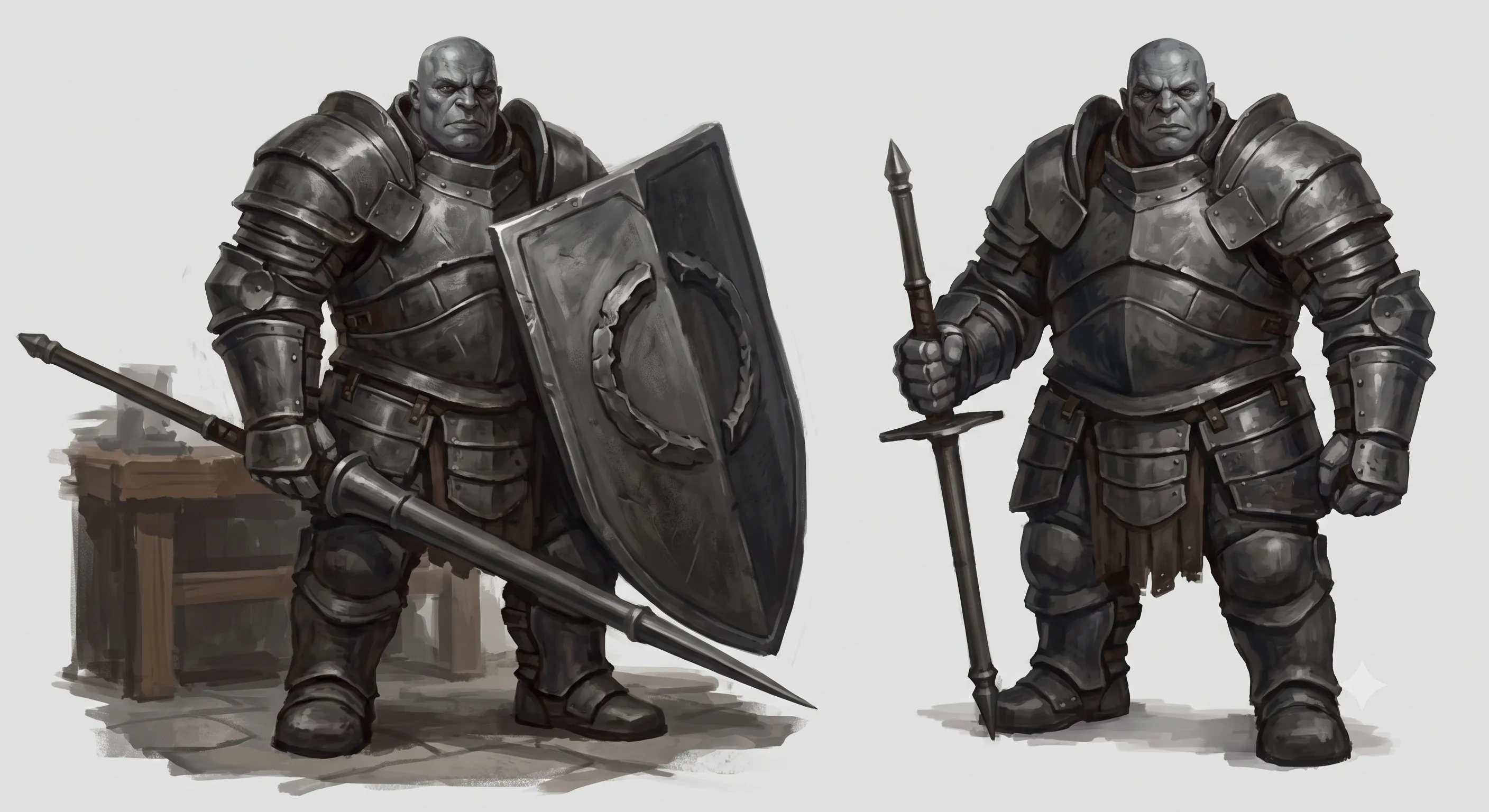
Plays like: the Barbarian’s endurance without the rage — the immovable juggernaut. If your fantasy is reckless, unarmored fury, this is not that class; if it’s being the last thing standing, it is exactly that class.
Identity: The Ironclast doesn’t dodge — it endures. Where casters bend a Working around a wound, the Ironclast simply refuses the wound its due. Bred from Kardun mountain-forges (though any soldier stubborn enough can take the Calling), it is oath-metal, dense bone, and a will that does not know how to break. It carries no Reaching, needs none, and stands where nothing else can.
“The mountain does not flinch when the storm arrives. It simply outlasts it.” — Kardun proverb, carved into the Ironclast’s forge-oath
Quick Build: Max Constitution first, Strength second. Choose heavy armor and a shield, a martial weapon, and smith’s tools. Pick the Bulwark path if you want to be the shield the rest of the party fights behind; Oathforge if you want your gear to be a character in its own right; Deepdelver if you want tunnels, breaches, and sieges to be your battlefield of choice; Avalanche if you want the rare Ironclast who stops enduring and starts falling on people.
Core Stats
Section titled “Core Stats”- Hit Die: d12 (HP: 12 + Con mod at 1st; 1d12 (or 7) + Con mod per level after)
- Primary Ability: Constitution
- Saving Throws: Strength, Constitution
- Armor: Light, medium, heavy, shields
- Weapons: Simple weapons, martial weapons
- Tools: Smith’s tools, mason’s tools
- Skills: Choose 2 — Athletics, Intimidation, Survival, History, Perception, Insight
- Starting Equipment: Chain mail or (scale mail + shield); a martial weapon and a second martial weapon or two handaxes; smith’s tools; an explorer’s pack; oath-metal ingot (heirloom, no mechanical effect until Oathforge)
Like everyone, the Ironclast can lend Unshaped Faith — spend 1 Hit Die’s worth of effort once per rest to grant an ally advantage or an extra Hit Die. No magic-blood required. Ironclasts who inherit or earn a bonded focus stone favor a Weight-bonded (blue) stone set in their armor — the Anchor (Chapter 9) is simply the mountain’s own opinion, worn.
Level Table
Section titled “Level Table”| Level | Prof. Bonus | Features | Grit Points |
|---|---|---|---|
| 1 | +2 | Ironclad Constitution, Grit | 3 |
| 2 | +2 | Fighting Style, Shrug It Off | 4 |
| 3 | +2 | Path chosen, Path feature, Open the Gate | 4 |
| 4 | +2 | Ability Score Improvement | 5 |
| 5 | +3 | Extra Attack, The Wall Hits Back | 5 |
| 6 | +3 | Path feature | 6 |
| 7 | +3 | Unbreakable Stance, The Mountain Endures | 6 |
| 8 | +3 | Ability Score Improvement | 7 |
| 9 | +4 | Last Stand | 7 |
| 10 | +4 | Path feature | 8 |
| 11 | +4 | Indomitable Body | 8 |
| 12 | +4 | Ability Score Improvement | 9 |
| 13 | +5 | Fortress of One | 9 |
| 14 | +5 | Path feature | 10 |
| 15 | +5 | Undying Grit | 10 |
| 16 | +5 | Ability Score Improvement | 11 |
| 17 | +6 | Second Wind of Stone | 11 |
| 18 | +6 | Grit Mastery | 12 |
| 19 | +6 | Ability Score Improvement / Feat | 12 |
| 20 | +6 | Immovable Object (capstone) | 13 |
Class Features
Section titled “Class Features”Ironclad Constitution (1st): While you wear heavy armor and are not incapacitated, you add your Constitution modifier to your AC. You also gain resistance to being frightened by anything without an Intelligence score of 8 or higher — you’ve simply seen worse.
Grit (1st): Your Grit pool (see table) refreshes fully on a short or long rest. Spend Grit Points as follows:
- Shrug It Off (reaction, when you take damage, cost 1 Grit; unlocked 2nd level): reduce the damage by 1d12 + your Constitution modifier. You can do this even against damage types you lack resistance to — it isn’t magic, it’s simply refusing to fall.
- Immovable (no action, when you’d be knocked prone, pushed, pulled, or forcibly moved, cost 1 Grit): the effect fails against you entirely. This works even against effects that don’t normally allow a save, so long as it’s physical force — magical teleportation and mind-affecting compulsion still work.
- Hold the Line (bonus action, cost 1 Grit): until the start of your next turn, any hostile creature that starts its turn within 5 feet of you has its speed reduced to 0 unless it succeeds on a Strength saving throw (DC 8 + prof. bonus + Con mod). You gain an opportunity attack with advantage against any creature that attempts to move away regardless.
- Open the Gate (bonus action, cost 1 Grit; unlocked 3rd level): you drop the guard on purpose — the gate stands open, and everything that walks through it gets answered. Until the start of your next turn, attack rolls against you have advantage, and your attack rolls have advantage. The mountain does not always wait for the storm.
- Breaker’s Blow (on hit, cost 1 Grit; unlocked 11th level): once per turn, when you hit with a weapon attack, channel the immovable weight of your whole stance into it — add 2d12 + your Constitution modifier bludgeoning damage (increasing to 3d12 + your Constitution modifier at 17th level). This is not magic; it is a mountain deciding to move exactly once. It is the Ironclast’s answer to the day the wall must also be the hammer, and it keeps your damage climbing alongside the blades and Workings around you.
- Last Stand (see 9th level).
Fighting Style (2nd): Choose one (see Chapter 2): Defense (+1 AC while you wear armor), Protection (while wielding a shield, use your reaction to impose disadvantage on an attack made against a creature within 5 feet of you), or Great Weapon Fighting (reroll a 1 or 2 on a damage die for a two-handed melee weapon).
Extra Attack (5th): You attack twice, instead of once, when you take the Attack action.
The Wall Hits Back (5th): When you use Shrug It Off, you may add your Constitution modifier to the damage of the next melee weapon attack you hit with before the end of your next turn. What they spent breaking against you, you hand back.
Unbreakable Stance (7th): As a bonus action, plant your feet: until you move, you have advantage on Strength and Constitution saving throws, and attacks against you have disadvantage unless the attacker is within 5 feet of you or the attack is ranged. Ends immediately if you move under your own power.
The Mountain Endures (7th): When you fail a Dexterity saving throw against an effect that covers an area, you may spend 1 Grit Point to treat it as a success. You don’t dodge the avalanche; you take it on your shoulders.
Last Stand (9th): When you’re reduced to 0 HP but not killed outright, you may spend 2 Grit Points (or none, once per long rest, free) to instead drop to 1 HP and remain standing. For the next minute, you’re not affected by anything that would ordinarily happen from being at 0 HP; when the minute ends, if you’re still at 1 HP or below, you fall unconscious as normal unless healed.
Indomitable Body (11th): You gain resistance to bludgeoning, piercing, and slashing damage from nonmagical weapons at all times (not just while raging or stanced) — this is who you are now, not a stance you take.
Fortress of One (13th): Your Grit maximum increases by your Constitution modifier (minimum +1), and Shrug It Off’s damage reduction increases to 2d12 + Con mod.
Undying Grit (15th): You automatically succeed on Constitution saving throws to avoid gaining a level of exhaustion, and you no longer suffer the speed-halving effect of exhaustion levels 1-3.
Second Wind of Stone (17th): Once per short rest, as a bonus action, regain Grit Points equal to half your Grit maximum (round up) without a rest.
Grit Mastery (18th): Grit costs for Shrug It Off, Immovable, and Hold the Line are all reduced by 1 (minimum 0) — you may use each once per turn at no cost.
Immovable Object (20th, capstone): Once per long rest, as a reaction to any single source of damage or forced movement, spend no Grit and simply negate it entirely — no roll, no save, it does not happen to you. In addition, while you have at least 1 Grit Point remaining, you cannot be reduced below 1 HP by any single instance of damage that does not exceed your HP maximum outright twice over.
The Four Paths
Section titled “The Four Paths”Path of the Bulwark — the shield the line stands behind
Section titled “Path of the Bulwark — the shield the line stands behind”The Bulwark is the Ironclast that turns its own unkillability outward. It has already decided that nothing gets through it; the Path is the second decision — that nothing gets past it to the smaller people behind, either — a body deployed as a gatehouse in front of everyone it has chosen to keep.
3rd — Living Wall. While you wield a shield and are not incapacitated, every ally within 5 feet of you gains a +1 bonus to AC and to Dexterity saving throws — they fight in the lee of the mountain, where the arrows land short and the blast rolls past. This bonus increases to +2 at 10th level. The benefit follows the shield rather than a fixed spot: it applies to any ally who is within 5 feet of you at the moment they are attacked or make the save, it requires no action, and it lasts for as long as you keep the shield up.
6th — Draw the Eye (bonus action). You make yourself the only target worth striking — a hammer rung on the shield-rim, a shout, a wall that dares them to try it. As a bonus action (no Grit), choose one creature within 30 feet that can see you; it must succeed on a Wisdom saving throw (DC 8 + your proficiency bonus + your Constitution modifier) or, until the end of your next turn, it has disadvantage on any attack roll that does not target you. If a creature marked this way attacks one of your allies anyway while the mark holds and that ally is within your reach, you may use your reaction to make one melee weapon attack against the attacker with advantage — the wall does not care to be ignored. Marking a new creature on a later turn ends the mark on any previous one.
10th — Take the Blow (reaction, 1 Grit). When a creature you can see hits an ally within 5 feet of you with an attack, you may use your reaction and spend 1 Grit to step across them: you become the creature the attack struck, and its damage is dealt to you instead of to the ally, applying your own resistances (you do not roll a new attack — the blow that already landed simply lands on you). As part of that same reaction you may spend 1 additional Grit to reduce the damage by 1d12 + your Constitution modifier, exactly as Shrug It Off — one reaction, one shield, the whole blow answered before it ever reaches the person you stepped in front of.
14th — Anchor the Line (bonus action, 2 Grit). You drive your stance into the ground and turn your footing into a formation the whole party can borrow. As a bonus action, spend 2 Grit; for 1 minute (no concentration required), you and each ally within 10 feet of you share the mountain’s footing. While an ally remains within 10 feet of you and the effect lasts, that ally cannot be knocked prone, pushed, pulled, or otherwise moved against their will by any effect an Ironclast could refuse (as your Immovable Grit option — magical teleportation and mind-affecting compulsion still work on them), and they have advantage on saving throws to avoid being frightened, grappled, or restrained. In addition, the first time each round that a sheltered ally would take damage, they reduce that damage by your Constitution modifier — a share of your own toughness, lent down the line. Allies who leave the 10-foot radius lose these benefits until they return; you may end the effect early as no action, and it ends if you fall unconscious.
Path of the Oathforge — the oath-smiths
Section titled “Path of the Oathforge — the oath-smiths”Kardun oath-smiths bind vows into forged gear, and the Oathforge lives by both hammer and stubbornness — treating its word and its steel as the same unbending thing.
3rd — Bespoke Steel. Using smith’s tools and 8 hours of work, you forge a personal weapon or shield so exactingly made that it counts as a magic item for the purpose of overcoming resistance (it isn’t magic — it is simply that well made). The piece is keyed to you; anyone else who wields it has disadvantage on attack rolls made with it.
6th — Word-Bound Vow. Once per long rest, you swear a vow of a single sentence about the current fight or quest — “I will not let this gate fall.” While the vow holds true, you gain a +2 bonus to saving throws and to any Grit-based DC you set. If you break your own vow, you gain a level of exhaustion.
10th — Reforge Under Fire. As an action, you repair your Bespoke Steel or a shattered piece of armor to full function in the field, and grant it a temporary +1 bonus that lasts until your next long rest.
14th — Unbreakable Oath. Your Word-Bound Vow (6th level) now also grants you immunity to being frightened or charmed for its duration. In addition, once per long rest, if you would drop to 0 hit points while your vow still holds, you instead drop to half your hit point maximum.
Path of the Deepdelver — the tunnel-fighters and siege-breakers
Section titled “Path of the Deepdelver — the tunnel-fighters and siege-breakers”Tunnel fighters and siege-breakers touched by the Kardun “Old Hunger” — a craft-fever that drives them to dig, build, and break fortifications with equal fervor. Where the Bulwark holds a line, the Deepdelver would rather bring the whole wall down.
3rd — Tunnel Sense. You have advantage on ability checks made to detect traps, structural weaknesses, or hidden passages in stone or earth, and you always know which way is up while you are underground.
6th — Siegebreaker. Your weapon attacks deal double damage to objects and structures. In addition, you can use mason’s tools to collapse a prepared section of wall or ceiling as an action, against a DC the GM sets based on the material.
10th — Old Hunger. Once per long rest, as a bonus action, you enter a craft-fever for 1 minute. While it lasts, your weapon attacks deal an extra 1d8 damage against constructs, structures, and creatures with a movement speed of 0, but you have disadvantage on Wisdom (Perception) checks made against anything that is not directly threatening you.
14th — Bury the Line. As an action, spend 3 Grit to collapse the ground in a 15-foot radius centered on a point within 30 feet. The area becomes difficult terrain, and each creature in it must succeed on a Dexterity saving throw (DC 8 + your proficiency bonus + your Constitution modifier) or be knocked prone and buried to the waist, remaining restrained until it uses an action to dig itself free.
Path of the Avalanche — the mountain come loose
Section titled “Path of the Avalanche — the mountain come loose”Once in a long while an Ironclast stops enduring and starts falling on people. The Avalanche trades the wall’s patience for the landslide’s weight — a fury with no rage in it, only mass, momentum, and the growing certainty that it will not stop until whatever it is rolling toward is underneath it. It is the mountain that decided, this once, to become the slide.
3rd — Gathering Slope (bonus action, 1 Grit). As a bonus action, spend 1 Grit to come loose — an Avalanche that lasts 1 minute. It ends early if you fall unconscious, or if you end your turn having neither hit a creature nor taken damage since the end of your last turn (a mountain that stops moving is only a mountain again). While the Avalanche lasts:
- You build Momentum. You start each Avalanche at 0 Momentum. You gain 1 Momentum the first time on each of your turns that you hit a creature with a melee weapon attack, and 1 Momentum the first time you take damage on any turn (yours or another creature’s). Your Momentum can be no higher than your Constitution modifier (minimum 1).
- Your melee weapon attacks deal extra bludgeoning damage equal to your current Momentum.
- You give up the wall to do it: you lose the bonus to AC from Ironclad Constitution, and you cannot use the Immovable, Unbreakable Stance, or Shrug It Off Grit options. The mountain cannot brace and fall in the same breath.
Your Momentum drops to 0 the moment the Avalanche ends.
6th — Break Wide (part of the Attack action, 1 Grit). The landslide does not get to choose just one thing to land on. While an Avalanche is active, once on each of your turns when you take the Attack action, you may spend 1 Grit to turn one of those attacks into a sweep: make a single melee weapon attack roll and apply it separately against the AC of each creature of your choice within your reach. Roll the weapon’s damage once; every creature the sweep hits takes that damage plus your current Momentum. In addition, whenever you reduce a creature to 0 hit points or score a critical hit with a melee weapon attack during an Avalanche, you gain 1 Momentum and may immediately move up to 5 feet without provoking opportunity attacks — the slide already looking for the next thing to come down on.
10th — Downhill All the Way. The Avalanche learns to feed on your own blood. Your Momentum maximum increases to your Constitution modifier + your proficiency bonus. In addition, while an Avalanche is active and you are below half your hit point maximum, you gain 2 Momentum (instead of 1) each time you take damage, and your Momentum cannot drop below half its maximum (rounded up) for the rest of that Avalanche — the wound is the fuel, and a wounded slope only gets heavier. Finally, while an Avalanche lasts you know no retreat: you are immune to being frightened, you ignore difficult terrain while moving toward a hostile creature, and any effect that would move you away from the nearest creature you can see moves you only half as far. The mountain has stopped bracing; now it will not even slow down.
14th — Come Down the Mountain (action, 3 Grit). You bring the whole slope down at once. As an action, spend 3 Grit — you must already be in an Avalanche, or you may start one as part of this action for its usual additional 1 Grit. Move up to your speed in a straight line without provoking opportunity attacks, ending in an unoccupied space, then make one melee weapon attack against each creature within 5 feet of where you stop. Each creature the attack hits takes the weapon’s normal damage plus your current Momentum. Choose one creature that was hit — the thing the full weight lands on: it takes an additional 2d12 + your Constitution modifier bludgeoning damage and must succeed on a Strength saving throw (DC 8 + your proficiency bonus + your Constitution modifier) or be knocked prone and buried, becoming restrained until it or a creature adjacent to it uses an action to dig it free. After the attack resolves your Momentum resets to 0, but the Avalanche continues — the slope keeps sliding, only lighter now, until it gathers again.