Chapter 6 — The Disciplines & the Cost of Magic
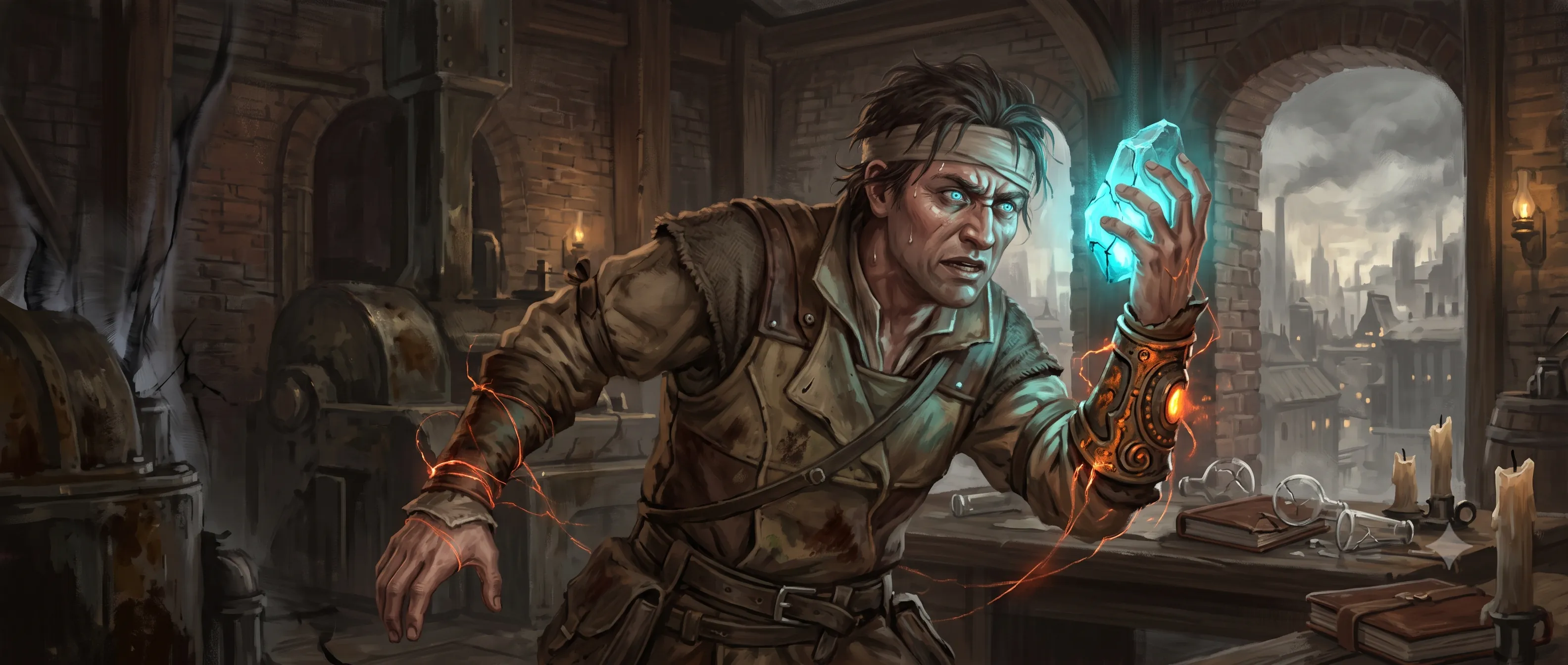
The apprentice asked her master why the great Binders of the old city were all so thin. “Because the light is not free,” he said. “It was only ever lent to us. Every ward I have ever raised, I raised against the same account — and the ledger is my own body. Look at my hands and you are reading my bill.” — from The Kindler’s Primer, a Temple teaching-text
Magic in Merretia is not a resource you own. It is a thing you are lent, and the whole of this chapter is the account you keep with what you borrowed. Where other traditions count neat slots that refill each dawn, a practitioner of the disciplines counts two very different clocks — one that scars the body and one that frays the self — and learns, painfully, which acts are worth which price.
This chapter replaces the standard spellcasting rules entirely. Everything else your character does — attacks, saves, ability checks, the action economy — runs on the ordinary rules in Chapter 10. Only magic works this way, and it works this way for a reason the whole world is built on: all light is lent, and called back in its time.
The Nine Channels
Section titled “The Nine Channels”Faith is the substrate of all magic. To shape faith is to run it through one of nine channels — archetypes older than humankind, the native tools of the angels and daemons, which mortals reach up to match at a cost. The nine sit on a single spectrum from purest Order to purest Chaos.
The four Order disciplines are the fundamental forces of the world made into faith-shapes. They are law-bound and deterministic — the bones of reality. Their colors emit: when an Order practitioner channels, the light seems lit from within.
| Discipline | Color | What it does |
|---|---|---|
| The Binding | yellow | structure, oaths, seals, contracts; can bind even light |
| The Weight | blue | gravity, density, foundations, mass, permanence |
| The Current | cyan | electricity, plasma, lightning; versatile reach |
| The Unmaking | orange | fire, rust, entropy, dissolution |
The four Chaos disciplines are the emergent currents of life and mind. They are generative and non-reducible — the life of reality. Their colors absorb: a Chaos channel reads as deep, matte, inked-in pigment, never a glow.
| Discipline | Color | What it does |
|---|---|---|
| The Growing | green | life, body, vitality, healing |
| The Knowing | magenta | mind, pattern, fact, illusion (it sits on the divide) |
| The Heart | red | emotion, the self reaching outward, moving a crowd |
| The Dream | indigo | the unconscious beneath all selves; the deep, transmuting current |
The ninth is not on the spectrum at all.Unshaped Faith (gold) is pure substrate, aimed across the gap between mortal and cosmos with no channel to shape it. It is treated on its own, below.
Every casting shows on your face. When you channel, your eyes flash the color of the discipline you are running — bright and unmistakable, gone the instant the Working lands. This is not flavor. A creature watching your face has advantage on Insight checks to identify what you are about to do and may react before it resolves. A practitioner who wants to cast unseen must hide their eyes, cast from cover, or strike from beyond the reach of a watching gaze.
Focus Stones
Section titled “Focus Stones”Every serious practitioner carries a focus stone: a clear crystal that takes on the color of whatever channel you run through it, and amplifies the Working. Your stone is what lets you reach above the base Tier of your discipline — without it, you are capped at the smallest cantrip-scale effects.
A focus stone is a real object in the world, and a real target. An opponent may attempt to sunder it as a called shot (the DC scales with the Tier you are channeling when struck). A shattered stone drops you to cantrip-tier magic until you can rebond a new one — a matter of days of quiet downtime, not a moment’s swap. Guard it.
Workings and Their Cost
Section titled “Workings and Their Cost”A single magical effect is a Working. Workings come in Tiers 1 through 9 (a Tier maps directly onto a legacy spell level, so any existing spell converts cleanly — a “3rd-level spell” is a Tier-3 Working). The smallest, at-will effects are cantrip-tier and cost nothing.
Every Working above cantrip-tier costs its Tier in points, added to one of your two tracks — and which track is decided entirely by which half of the spectrum you channeled.
THE TWO TRACKS Both tracks share the same cap: 10 + (your proficiency bonus × 2).
- Cast an Order discipline (Binding, Weight, Current, Unmaking) → add the Tier to your STRAIN.
- Cast a Chaos discipline (Growing, Knowing, Heart, Dream) → add the Tier to your FRAY.
They are the same number in opposite skins. The difference is everything.
STRAIN — the price the body pays
Section titled “STRAIN — the price the body pays”Order pours structural faith through your flesh, and the flesh pays: heat, nerve, tissue, the deep ache of a hard day’s labor. Strain is fatigue, and it clears completely on a short rest. Whatever you spend raising wards all afternoon, a fire and an hour’s rest burns off.
- When your Strain passes 75% of its cap, the next Order Working you cast also costs you one level of exhaustion (the ordinary exhaustion ladder from Chapter 10).
- When your Strain would exceed its cap, you face a single clean choice: Overchannel — cast anyway and take a level of exhaustion — or stop. There is no table to consult and no roll to make.
A Binder treats her cost in the same infirmary that treats a sword-cut. It is brutal, it is physical, and it is over by morning.
FRAY — the price the self pays
Section titled “FRAY — the price the self pays”Chaos pours generative faith through your interior, and the interior pays: vitality, the memory of what you love, the edges of your own identity. Fray does not clear on a short rest. A long rest spent in genuine devotional stillness heals half of it (a quarter if the rest is broken). What you spend here, you get back slowly, if at all — and never quite the same.
At character creation, every practitioner who runs a Chaos discipline writes a Loss Menu: six small, specific things your character could lose their grip on — the name of a childhood friend, the taste of your mother’s cooking, your fear of heights, the belief that you are a good person. You author them. The game only decides when they come up.
- When your Fray passes 75% of its cap, the next Chaos Working triggers a d6 against your Loss Menu — the die selects which of your six things slips, for a time or for good, as the fiction demands.
- When your Fray would exceed its cap, you may Overchannel — cast anyway and name, on the spot, one small permanent thing your character loses. No roll. The choice, and the grief of it, are yours.
Your GM will never roll a loss against you out of nowhere. The losses are yours to write and, at the edge, yours to choose. That is the whole point: Chaos does not damage you. It spends you.
The Break
Section titled “The Break”If you push past Overchannel — if you refuse to stop at the cap and keep pouring — you risk the Break. It is rare, and it is meant to be terrifying.
- An Order practitioner who Breaks collapses at 0 hit points and begins dying: the body simply gives out under a load it was never built to carry.
- A Chaos practitioner who Breaks suffers an Unraveling — the GM removes a defining trait of the character, no save. Not a small thing from the menu. A load-bearing one.
The Break is the wall at the end of the ledger. Almost no one who has seen it wants to see it twice.
Faith Is Depth, Not Training
Section titled “Faith Is Depth, Not Training”Two practitioners of equal schooling do not cast equally. The stronger is simply the one who believes more completely. A Binder who has given her whole life to the truth that a promise can hold the world together will raise a ward that a merely competent Binder cannot — the same technique, a deeper faith.
This is your Conviction, rated 1 to 5, which sets your Faith Die:
| Conviction | 1 | 2 | 3 | 4 | 5 |
|---|---|---|---|---|---|
| Faith Die | d4 | d6 | d8 | d10 | d12 |
Every character begins at Conviction 1. It does not rise with your level or your training. It rises only when the GM judges that you have held your faith at a genuine cost — kept an oath that hurt to keep, moved a crowd when it was dangerous to try. Belief is earned in the story, not bought on the sheet.
How the Faith Die works. Before you add a Working’s Tier to Strain or Fray, roll your Faith Die and subtract it (you always add at least 1). Deep faith makes the same magic cost you less of yourself.
And when a Working sits dead-center of your character’s Tenet — the single sentence you wrote to name what your character believes above all else — you roll the Faith Die twice and take the higher. Faith is cheapest when it is truest.
A NAMED RULE — ACCESS vs COST. Your Calling and its Reaching decide the highest Tier you can attempt. Your Conviction decides what that attempt costs you. These are two different dials and must never be collapsed into one. A low-Conviction prodigy can reach for enormous Workings — and be gutted by them. A high-Conviction devotee casts small Workings almost for free. Keep them separate; it is the heart of how this magic feels.
Unshaped Faith — the Gold that Anyone May Spend
Section titled “Unshaped Faith — the Gold that Anyone May Spend”Not all faith is shaped. Unshaped Faith is the gold miracle: raw substrate poured toward a target to make it, for a moment, more real — steadier, luckier, more itself.
Any character who carries faith at all — which is to say everyone, caster or not — may spend 1 point from either track to grant a creature they can see either advantage on one roll or one extra Hit Die of recovery. No Tier. No roll. No failure.
This is the setting’s promise that no one is magically mute. The Kardun ironclast who has never run a channel in her life can still lay a hand on a dying friend and lend him something of herself. It costs her — a point is a point — but the door is never locked.
The Hollow — the Channel with No Price You Can See
Section titled “The Hollow — the Channel with No Price You Can See”There is a tenth way to move faith, and it is forbidden in every province, every temple, and every guild that has ever named it.
The eight disciplines and unshaped Faith all pay their cost out of you. The Hollow does not. It routes faith through the Wound in the world — the tear where relation ends — and the Wound has nothing of its own to pay with. So the cost goes somewhere else. Somewhere out in the world. Somewhere later.
To the practitioner, Hollow-work feels like a gift. There is no Strain. There is no Fray. The greatest Workings come at no price your sheet can show, and your eyes do not flash a discipline’s color — they go black, empty of medium, a hole where a color should be.
And that is the whole of the horror. You will feel fine. You will feel better than fine — capable of things the disciplined can only ache toward. The bill is real, and it is enormous, and it is being paid by the world around you: the weather curdles, the luck of a district sours, things that should not wake begin to stir near where you worked. You simply are not the one holding the receipt.
Your character does not track a Hollow cost. There is nothing on the sheet to track. Whether the world is already paying — and how much — is your GM’s to know and yours to dread.
Reaching a Discipline
Section titled “Reaching a Discipline”You do not “know spells.” You hold a Reaching — a trained connection to a single discipline, granted by your Calling (Chapter 4) at the level a caster would come into their power. A Reaching gives you the discipline’s toolkit of Workings up to a Tier your Calling’s progression sets, and every Working you cast through it draws on the two-track economy above.
Most practitioners hold one Reaching their whole lives. It is who they are: a Binder, a Grower, a Heart-worker. A very few hold two — and those two are almost never on the same side of the spectrum.
Twofold Faith — the Prophesied Cross
Section titled “Twofold Faith — the Prophesied Cross”To hold a Reaching in both an Order and a Chaos discipline is the rarest thing a practitioner can be. The world tells stories about them and writes prophecies around them, because it takes a faith supple enough to hold two opposed archetypes at once without tearing.
You cannot begin play this way, and you cannot reach it by the ordinary trading of a multi-Calling character. It is available only through the Twofold Faith feat-chain, and only when your GM judges that the story itself has forged the crossing — and only along one of the four canonical pairings (Binding–Knowing, Weight–Growing, Current–Heart, Unmaking–Dream). Even then, your two disciplines do not give you two economies: they feed one interleaved track, and pushing it drives you toward a temporary Fracture far faster than a single-Reaching practitioner ever risks.
The one exception is the Zar’ir Adept, the church-trained caste who are taught a pre-paired, half-strength crossing as doctrine from the start — the sanctioned, careful version of the thing that, in anyone else, is a legend.
Summary — Reading Your Own Ledger
Section titled “Summary — Reading Your Own Ledger”- Choose your channel. Order costs Strain (body). Chaos costs Fray (self).
- Your eyes flash the discipline’s color. Everyone can see what you’re doing.
- Roll your Faith Die, subtract it from the Working’s Tier (twice-take-higher if it’s dead-center of your Tenet), and add the rest to the matching track.
- Strain clears on a short rest. Fray does not — and its losses are the ones you wrote yourself.
- Overchannel past your cap for a price; Break past that at your peril.
- Unshaped Faith is the gold door no one is locked out of.
- The Hollow costs you nothing you can see — and that is exactly why you must never.