Chapter 10 — Playing the Game
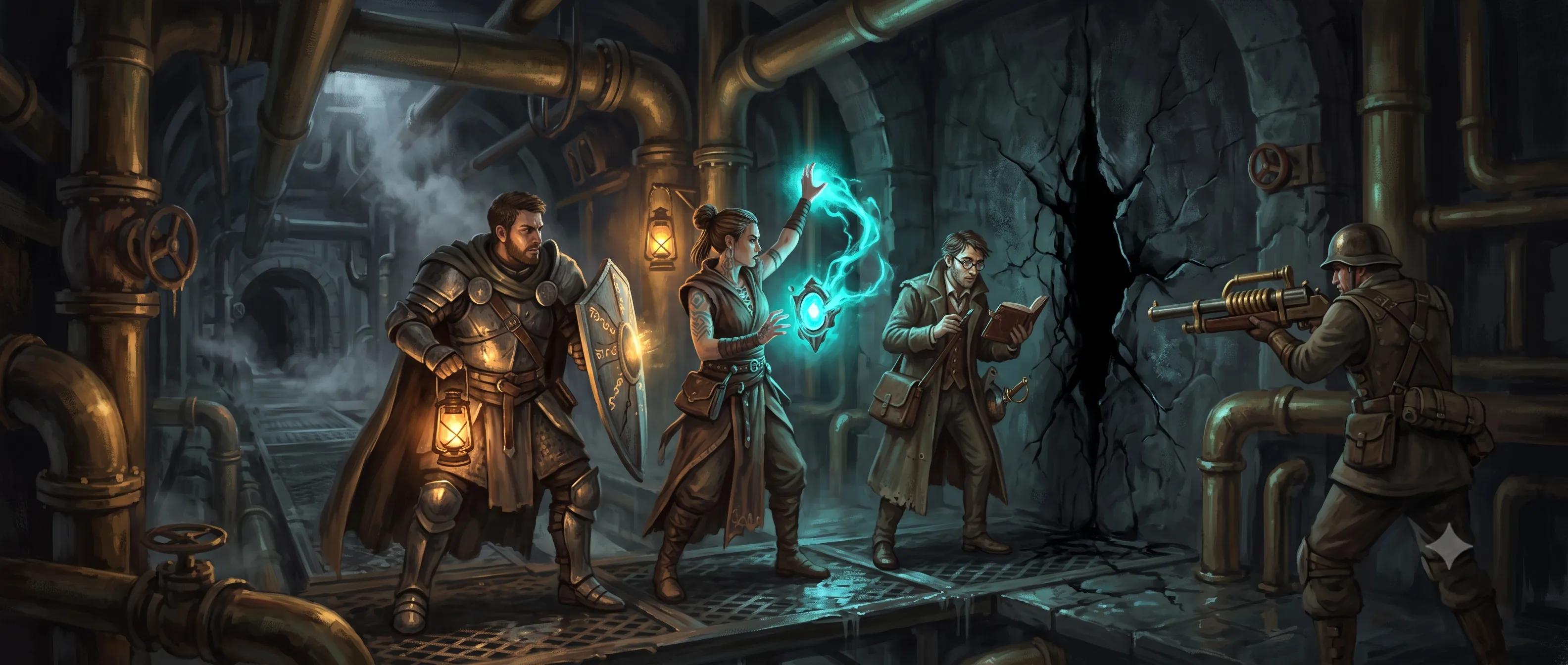
This chapter and the next are the engine: how the dice resolve what your characters attempt. Merretia runs on the standard d20 rules (the SRD 5.2 core), so if you know them, you already know most of this. Rather than reprint the whole ruleset, this chapter states the core loop briefly and then spells out the places where Merretia changes how play works — the eye-flash, the cost-tracks, the grid, unshaped Faith. Where a rule isn’t modified here, use the standard rule.
The core resolution
Section titled “The core resolution”When an outcome is uncertain, someone rolls a d20, adds the relevant modifier and (if proficient) their proficiency bonus, and compares the total to a target:
- an ability check against a Difficulty Class (DC) the GM sets,
- an attack roll against a target’s Armor Class (AC),
- a saving throw against a DC set by the effect.
Roll high. Advantage (roll two d20s, keep the higher) and disadvantage (keep the lower) never stack — you have one or the other or neither. The six abilities (Strength, Dexterity, Constitution, Intelligence, Wisdom, Charisma), skills, passive checks, and the standard DC bands all work as in the core rules.
Ability checks in Sulamir
Section titled “Ability checks in Sulamir”The skill list is standard; the flavor of a few checks is worth naming, because they come up constantly here:
- Insight is the survival skill of a three-layered city — reading a stranger’s guild or House allegiance, sensing a debt behind a smile, catching the half-second before an oath is broken.
- Arcana covers the disciplines: identifying a channel by its colour, knowing what a focus stone can do, recognizing a standing work.
- History in Sulamir is guild history and House history — who owes whom, and since when.
- A character trained in a discipline may substitute Faith-based knowledge (their casting ability) for Arcana when the question is about the channels themselves.
Resting — and the grid
Section titled “Resting — and the grid”Short rests and long rests work as standard, with two Merretian wrinkles that matter enormously:
- Strain clears on a short rest; Fray does not. This is the single most important rest rule for a caster (Chapter 6). A long rest of genuine, undisturbed stillness restores half your Fray; a broken rest, a quarter. Plan your rests around your self, not just your body.
- Charge does not rest. Your buried-sun cells do not refill overnight. They recharge only on the grid, at a recharge post (Chapter 8). A long rest in Sulamir tops you off; a long rest three days into the frontier does nothing for a dead cell. Track your shots.
The environment
Section titled “The environment”Standard rules cover falling, suffocation, hunger, and extreme cold and heat. Merretia adds a few characteristic hazards the GM will reach for:
- The deep and the dark. The under-city and the Rhydin levels are lightless; bring a grip-lamp or the right eyes.
- Grid-dead country. Past the last recharge post, charged gear is a countdown — a resource pressure the GM can lean on as surely as rations.
- Hollow-thinning. Near a Hollow-breach, reality frays: the GM may call for saves against dread, disorientation, or worse (the full effects are the GM’s, Master’s Guide).
Unshaped Faith as an action
Section titled “Unshaped Faith as an action”No one in Merretia is magically mute. Any character, caster or not, may take an action (or the action their feat/Calling specifies) to lend unshaped Faith to a creature they can see: spend as the rules in Chapter 6 describe to grant that creature advantage on one roll or one extra Hit Die of recovery. It costs the lender something small every time — but the door is never locked, and a party’s magic-free members are never truly out of the miracle business.
What carries into combat
Section titled “What carries into combat”Two Merretian facts change how a fight actually plays, and they live in the next chapter: casting is visible (your eyes flash your discipline’s colour, and enemies can read it), and charged weapons can jam if you push them. See Chapter 11.
Chapter 11 — Combat
Section titled “Chapter 11 — Combat”Combat uses the standard initiative, turns, actions, movement, cover, and damage rules. This chapter assumes them and details only what Merretia adds or changes.
The visible caster
Section titled “The visible caster”When you cast a Working, your eyes flash the colour of the discipline (Chapter 6) — bright, unmistakable, and gone the instant the Working lands. This is a real tactical fact, not flavor:
- A creature that can see your face has advantage on any check to identify what you are about to do, and may react before the Working resolves (readying an action, diving to cover, interrupting).
- To cast unseen, you must break line of sight to your target’s eyes — hide your face, cast from cover or the dark, wear an eye-shroud (Chapter 8), or strike from beyond the range of a watching gaze.
- Hollow-work flashes no colour: the eyes go voided black. On a battlefield, that is the most feared thing anyone can see, and it is always the wrong answer.
The cost of casting, in the moment
Section titled “The cost of casting, in the moment”Casting a Working is an action (or the time its source specifies). Resolving it, you subtract your Faith Die and add the remaining Tier to your Strain or Fray (Chapter 6). Reaching your cap forces the Overchannel choice mid-fight; pushing past it risks the Break. A caster’s real ammunition is their own two clocks — a party that treats a channeler like an inexhaustible artillery piece will watch that channeler come apart.
Arc-locks and charged weapons
Section titled “Arc-locks and charged weapons”Arc-locks (Chapter 8) fire a physical slug and use the standard ranged-attack rules, with three riders:
- The cell is your ammunition. Each shot spends one of the cell’s charges. An empty arc-lock is an improvised club until you swap a cell (an action) or reach the grid.
- Coil-jam. Arc-locks are built for measured fire. If you fire the same arc-lock more than once on your turn (via Extra Attack, action surges, and the like), each shot after the first risks overheating the coil-throat: roll the attack, and on a natural 1–2 the weapon jams and cannot fire until you spend an action to clear it. Disciplined shooters fire in single, called shots.
- Silent fire. Arc-locks make no muzzle flash and no smoke — the thoom is loud but directionless, granting no automatic reveal of a hidden shooter’s exact position (GM’s discretion). The one exception is the powder-lock (Chapter 8), which is loud, smoking, and gives your position away — and is illegal to fire under the Dome.
Oath-metal and the martial line
Section titled “Oath-metal and the martial line”An oath-metal weapon counts as magical for overcoming resistance only while its wielder holds the vow sworn into it (Chapter 8); a forsworn blade is fine steel until re-sworn. The standing shield’s bound-light face works against physical and arc-lock attacks like any shield — it is tech, not a Working, so it functions in an anti-magic field.
Targeting the caster’s kit
Section titled “Targeting the caster’s kit”Two called-shot options the GM may allow, both thematic to the world:
- Sunder a focus stone. A caster’s focus stone (Chapter 6) can be targeted as a called shot (AC and required damage by the GM, scaling with the Tier being channeled). A shattered stone drops the caster to cantrip-tier Workings until they rebond a new one over downtime.
- Break an oath under pressure. Against a Vowbound or a Halkari (Chapter 4), forcing a situation that makes them break a sworn vow or Stand is a legitimate tactic — the mechanical penalties are on their character sheet, and a canny enemy will engineer exactly that.
Conditions
Section titled “Conditions”The standard conditions apply. Two Merretian states extend the ladder and are detailed on the character sheets that use them:
- Overchannelled / Broken (Chapter 6) — the states a caster enters at and past their cost cap.
- Corroding (from Unmaking effects, Chapter 4 / Chapter 7) — a stacking −1 to AC as rust eats gear, cleared with a short rest’s maintenance.
Everything else — grappled, prone, restrained, frightened, unconscious, and the rest — is standard. The frightened condition is worth flagging as central here: in a world where a stranger’s eyes going bright can end a fight, fear is a weapon, and several disciplines and peoples wield it directly.