Chapter 1 — Welcome to Merretia
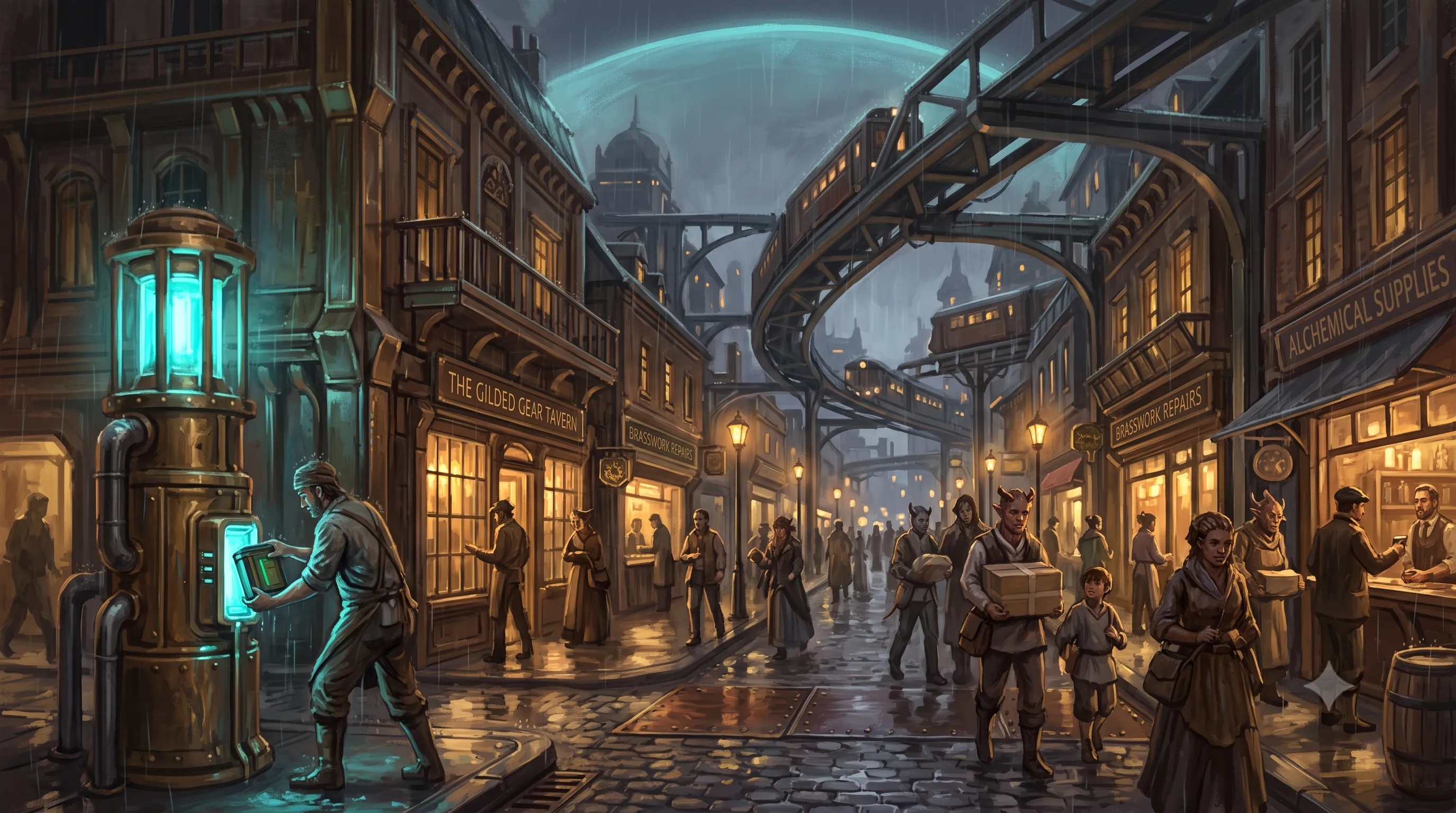
There is a sound they make in Sulamir when a rifle fires — not a crack, not a bang, but a compressed thoom, like a door slamming shut on the world, and then a half-second of ringing silence while the air rushes back to fill the space the shot left behind. You will learn that sound. You will learn to fear a different one more: the small, wet catch of breath a person makes the instant before their eyes go bright, because that is the sound of someone deciding that whatever they are about to do is worth what it will cost them.
Welcome to Merretia. Everything here has a price, and the whole game is about who is willing to pay it.
What this game is
Section titled “What this game is”This is a tabletop roleplaying game. One of you is the Game Master (the GM), who plays the world — its people, its dangers, its weather and its wants. The rest of you each play one character, a person living in that world with their own history, gifts, and debts. Together you tell a story that none of you could have written alone: the GM sets a scene, you say what your characters do, and the dice decide the outcomes no one is sure of.
If you have played a game like this before, the bones will feel familiar — you roll a twenty-sided die, add a number, and try to beat a target. What is not familiar is the world those bones live in, and one system at its heart that works like nothing you’ve played before. That difference is the point.
The world in a breath
Section titled “The world in a breath”Sulamir is the great city — an electrified, rail-connected megacity of guilds and great Houses, the economic and technological heart of a whole continent, sheltering under a Dome: an ancient energy-shield, raised in a forgotten age, that turns away armies and monsters alike. Trains run out from under it to the far provinces; airships cross above it; and beneath it, in sunless galleries, buried suns hum in the deep and light the streets overhead.
Magic is real, and it is faith. To work it is to shape your own conviction through one of nine disciplines — the fundamental forces of order (structure, weight, current, fire) and the emergent currents of chaos (life, mind, heart, dream). But magic is rare — perhaps one person in thousands can truly wield it — and it is never free. Every Working is paid for out of the caster: the disciplines of order cost the body, the disciplines of chaos cost the self. This is the first law of the world, and its people say it like a prayer and a warning both: all light is lent.
So the great powers of the world are wielded by an exhausted few, and everyone else fights, builds, and lives by other means — oath-metal blades that hold a sworn promise in the steel, charged arc-locks fed by the grid, and the coin of the Iron Coin, in a city where a signature is very nearly money and everyone owes someone by nightfall.
And at the edges of all of it, seeping through the seams the Dome cannot close, there is the Hollow — the Wound in the world, the place where relation ends. It is not a monster. It is an absence, and it is patient, and the one power that costs its user nothing is the one that feeds it.
What makes Merretia itself
Section titled “What makes Merretia itself”Plenty of worlds have wizards and swords. Here is what you will not find anywhere else:
- Power that costs you something you’ll miss. Casters track two clocks, not spell slots — a body that scars and heals, and a self that frays and never quite grows back the same. When you push a chaos discipline too far, you don’t lose “a spell.” You lose a memory, a feeling, a scruple — one you chose and wrote down yourself. The most human thing on a character sheet in this game is the short list of what you’re afraid to lose.
- Belief, not training, is strength. Two equally-schooled casters are not equal; the stronger simply believes harder. Your Conviction rises only when the story earns it — when you keep an oath at real cost, when you move a crowd when it’s dangerous to try. Faith is something you do.
- Everything is order and chaos, in a truce. Nothing that exists is pure. Every god, every people, every person is a compound of the two great forces, tilted one way and cracked the other. Your lineage isn’t a bundle of bonuses; it’s which truce you are.
- Magic is elite; the world is not. Because so few can cast, the world runs on magitech and muscle — and a hero with no magic at all (a duelist, an unbreakable Kardun wall) is never the lesser for it. That’s a promise this book keeps.
- Oaths are load-bearing. This is a civilization built on sworn word — guild oaths, House oaths, the vow spoken into a blade at the forge. Break one and the world notices, sometimes in your body.
How to play
Section titled “How to play”Play flows as a conversation with dice in it:
- The GM describes a situation. You’re in it — a smoke-thick tavern, a sealed vault, a Hollow-breach on the frontier.
- You say what your character does. Talk, sneak, strike, cast, bargain, run.
- The dice settle the uncertain. When success isn’t guaranteed, you roll; the GM narrates what happens; the scene moves on.
Everything you do falls into one of the game’s three pillars, and Merretia gives each its own texture:
- Exploration — crossing the continent by magnerail and the frontier on foot; the deep levels beneath the city; the countdown that starts the moment you walk past the last recharge post and your charged gear is on a timer.
- Social interaction — the three-layer politics of guilds, Houses, and the shadow-Council; a world where reading a stranger’s guild allegiance from their bearing is a survival skill, and a debt is a leash.
- Combat — fast and lethal, decided as often by an oath kept or a channeler’s ninety seconds of terrible power as by the number of soldiers on the line.
The GM is not your opponent. The GM is the world, and the world is neutral — it simply responds, honestly, to what you do.
The dice
Section titled “The dice”You’ll use the standard polyhedral set. The core roll is the d20: roll it, add the relevant modifier, and compare to a target (a Difficulty Class, or an enemy’s defense). Roll high.
- “3d6” means roll three six-sided dice and total them; “1d8 + 3” means roll a d8 and add 3. The number before the d is how many dice; the number after is the die’s size.
- Advantage means roll two d20s and take the higher; disadvantage, the lower.
- A natural 20 on an attack is a critical hit; a natural 1 always misses.
Full rules for checks, combat, and adventuring are in Chapters 10–11. You don’t need them to start — you need a character and a first scene.
How this book is arranged
Section titled “How this book is arranged”- Chapter 2 — Making a Character walks you through building someone, start to finish.
- Chapter 3 — The Peoples is what you are: the lineages of Merretia and their traits.
- Chapter 4 — Callings is what you do: the ten classes, from oath-knight to foundry-soldier to the scarred edge-walker.
- Chapter 5 — Origins is where you come from: the guilds, Houses, and hard places that shaped you (and where your ability scores come from).
- Chapter 6 — The Disciplines & the Cost of Magic is the heart of the book: how faith becomes power, and what it takes.
- Chapter 7 — Spells is the caster’s menu, sorted by discipline.
- Chapter 8 — Equipment & the Lent Grid is what you carry and how you pay for the light.
- Chapters 10–11 are the core rules of play and combat.
One last thing before you begin
Section titled “One last thing before you begin”You will find this world both stranger than you expect and, in odd moments, more familiar than it has any right to be. Sit with that when it happens. For now, all you need is a character with something to protect and something to prove — and the willingness, when the moment comes and everything hangs on it, to decide that what you believe is worth what it will cost.
Then take a breath, and let your eyes go bright.