The Cindermarch
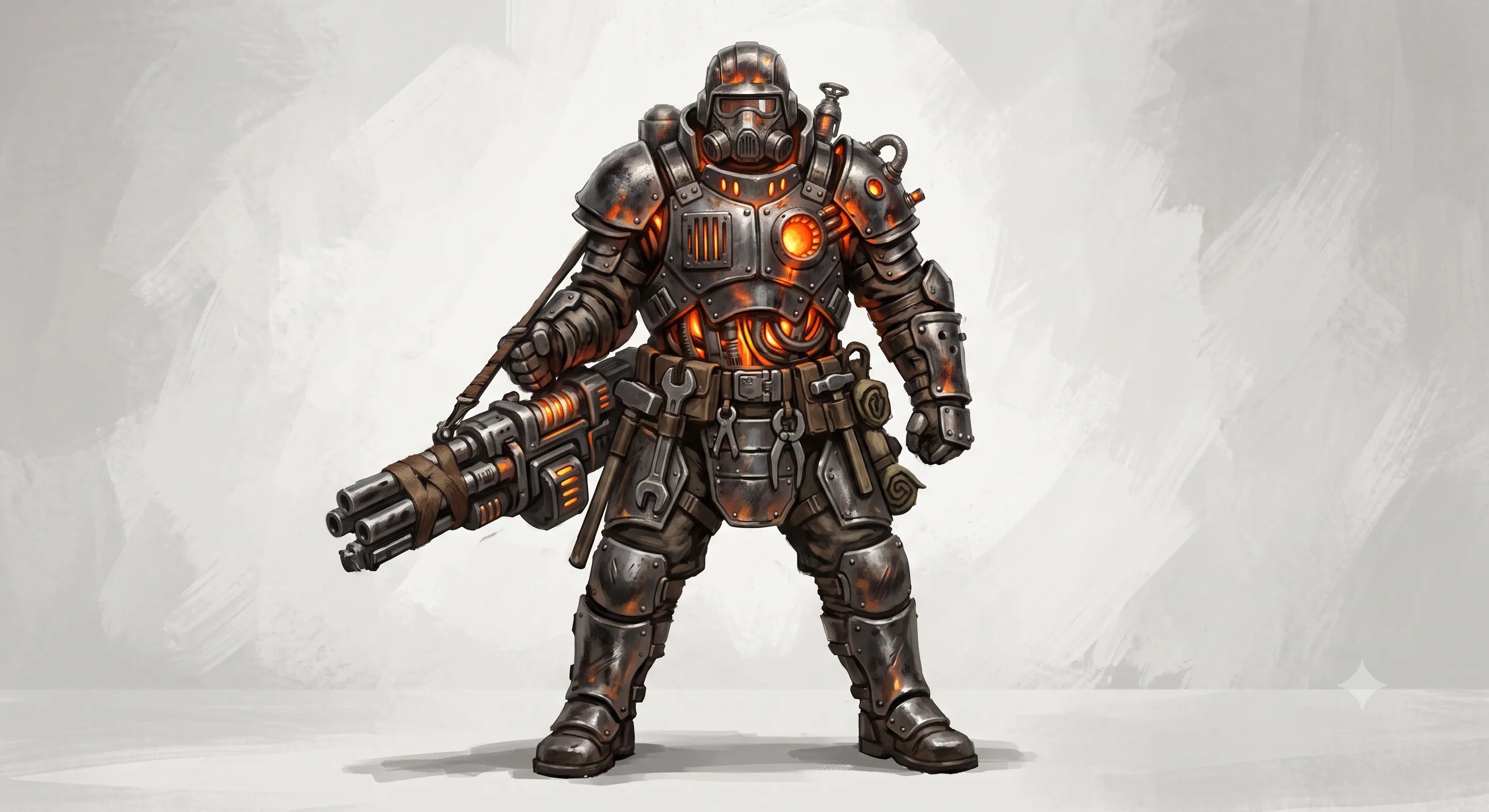
Plays like: the Sorcerer — raw power in a soldier’s frame, burning hot and close.
The Cindermarch is a foundry-forged soldier who has bonded body and blood to buried-sun tech: furnace-cores salvaged from the dead forges of an older age, worked through the Unmaking into a weapon that lives on their skin. They are artillery given legs — walking closer to the fight than any sane blaster should, because the Cindermarch’s power is a gauge that climbs the longer they burn, and burning close is how you win. Play this if you want a front-line caster who trades caution for tempo: every round you don’t spend your Heat is a round it’s spending you.
“The forge doesn’t ask if you’re ready. It asks if you’re still standing when the ash settles. Be standing.” — Ferro Ashvane, Cindermarch of the Ninth Bellows
Quick Build & Core Stats
Section titled “Quick Build & Core Stats”Quick Build: Constitution as your highest score (your save DC and Slag Bolt run on it — the forge is in the blood), then Strength, then Wisdom. Choose the Athletics and Intimidation skills. Take the Forgeblade and half plate from starting equipment.
- Hit Die: d8 (Hit Points: 8 + Con modifier per level, 1st level = 8 + Con mod)
- Primary Ability: Constitution (or Strength)
- Saving Throws: Strength, Constitution
- Armor: Light armor, medium armor, shields
- Weapons: Simple weapons, martial weapons
- Tools: Smith’s tools, tinker’s tools
- Skills: Choose 2 from Athletics, Insight, Intimidation, Investigation, Perception, Survival
- Starting Equipment: A Forgeblade (martial melee weapon; doubles as your Focus Stone) or a Cinderlance (martial reach weapon); half plate or scale mail; smith’s tools; a burial-coal satchel (10 charges of ignition dust); an explorer’s pack; 30 gp
The Level 1–20 Table
Section titled “The Level 1–20 Table”| Level | Prof. Bonus | Features | Heat Capacity | Heat-Shaping Known | Max Working Tier |
|---|---|---|---|---|---|
| 1 | +2 | Forge-Sworn (Reaching: Unmaking), Forgeblade, Heat, Slag Bolt | 6 | — | 1 |
| 2 | +2 | Cinder Sense, Quick Vent | 6 | — | 1 |
| 3 | +2 | Forge-Rite (Path), Heat-Shaping | 6 | 2 | 2 |
| 4 | +2 | Ability Score Improvement | 6 | 2 | 2 |
| 5 | +3 | Extra Attack | 8 | 2 | 3 |
| 6 | +3 | Forge-Rite feature | 8 | 2 | 3 |
| 7 | +3 | Molten Momentum | 8 | 3 | 3 |
| 8 | +3 | Ability Score Improvement | 8 | 3 | 4 |
| 9 | +4 | Tempered Body | 8 | 3 | 4 |
| 10 | +4 | Forge-Rite feature | 10 | 3 | 4 |
| 11 | +4 | Searing Reserve | 10 | 4 | 5 |
| 12 | +4 | Ability Score Improvement | 10 | 4 | 5 |
| 13 | +5 | Bellows-Breath (Heat cooling improves) | 10 | 4 | 5 |
| 14 | +5 | Forge-Rite feature | 10 | 4 | 5 |
| 15 | +5 | Undying Ember | 12 | 5 | 6 |
| 16 | +5 | Ability Score Improvement | 12 | 5 | 6 |
| 17 | +6 | Second Wind of the Forge | 12 | 5 | 6 |
| 18 | +6 | Master of the Break | 12 | 5 | 6 |
| 19 | +6 | Ability Score Improvement/Feat | 12 | 5 | 6 |
| 20 | +6 | The Undying Forge | 14 | 5 | 6 |
Class Features
Section titled “Class Features”Forge-Sworn (Reaching: the Unmaking). At 1st level your Calling grants a Reaching into the Unmaking — the Order discipline of fire, rust, and entropy — up to the Max Working Tier on the table. Casting a Working through this Reaching draws Strain as normal (clears on a short rest; 75% cap costs 1 exhaustion on cast; cap forces Overchannel or a stop). Your eyes flash burnt orange-red on every cast; the color EMITS, and it’s bright enough that allies can read your intent as easily as enemies can (their Insight check to read you has advantage, per the core rule).
Forgeblade. Your bonded weapon is a magitech martial weapon (melee or reach, your choice at creation) forged around a shard of buried-sun tech. It functions as your Focus Stone: casting an Unmaking Working above cantrip-tier requires you to be holding or wearing it. While wielding it, your weapon attacks deal an extra 1d4 fire damage and count as magical for resistance/immunity purposes.
Sundered blade. A Cindermarch is the exception to the standard sunder rule — the forge is in your blood, and the blade is only its spout. If a called shot sunders your Forgeblade, you do not drop to cantrip-tier; you lose precision, not power. Until you rebond it over downtime (the standard days-long rite), your Unmaking attack rolls (including Slag Bolt) are made at disadvantage, each Heat-Shaping technique costs 1 additional Heat, and you cannot use Twin Burn or Far Bellows at all — bare hands can pour the fire, but they cannot aim it twice or throw it far.
Forge in the Blood (save DC). Your Cindermarch save DC — for Heat thresholds, Vents, Path detonations, and your Unmaking Workings — is 8 + your proficiency bonus + your Constitution modifier. Other practitioners shape faith with a trained mind; you shape it with a body built to hold a furnace. What you can survive is what they must.
Heat. Your signature resource is a gauge from 0 up to your Heat Capacity (see table). Heat represents literal, dangerous overtemperature in your forge-core and armor plating — a faster, in-combat cousin of Strain. Heat rises and falls on its own quick clock during a fight, but the forge always bills the body when it boils over: the moment you discharge Heat — any Vent, an Overheat, or a Path detonation (Controlled Vent, Push the Burn, Supernova, and the like) — you also add 1 Strain to your track (before the Faith Die), and if that carries you to 75% of cap or past it, the ordinary exhaustion and Overchannel rules apply. Heat lets you burn fast; it never lets you burn free. Nothing in the world is lent without an account, and the Cindermarch’s account is settled in the same flesh every Order-caster pays with.
Generating Heat: You gain Heat equal to a Working’s Tier (minimum 1) whenever an Unmaking Working you cast deals damage or destroys/corrodes something. You also gain 1 Heat whenever a Forgeblade or Cinderlance attack you make hits.
Heat thresholds: While your Heat is 5 or higher, your Unmaking Workings and Forgeblade fire damage ignore resistance to fire. While your Heat is 8 or higher, any creature damaged by your Working or Forgeblade attack must succeed on a Constitution save (against your Cindermarch save DC — see Forge in the Blood) or gain the Corroding condition (–1 to AC, cumulative, until it takes a short rest to scrape the rust off).
Cooling: At the end of your turn, if you gained no Heat that turn, your Heat drops by 2 automatically (it radiates off). Heat fully resets to 0 on a short or long rest.
Overheat & Venting: When your Heat reaches its Capacity, you are Overheated. On your next turn you must choose:
- Controlled Vent (no action): discharge all your Heat in a 10-foot-radius burst centered on you — each creature of your choice in range takes 1d6 fire damage per 2 points of Heat spent (Dex save for half, DC as above). Heat resets to 0.
- Push the Burn (push-your-luck): hold your Heat at Capacity for one more round to fuel your next Working or Path feature at maximum effect. If you haven’t vented by the start of your following turn, the forge-core burns you: take 2d6 fire damage (no save), gain one level of exhaustion, and Heat resets to 0.
Slag Bolt 1st Artillery walks close, but it is still artillery. As an attack (usable with the Attack action, and twice once you have Extra Attack), you spit a slug of molten slag from your Forgeblade — or your bare palm — at a target you can see within 60 feet: make an attack roll using your save DC’s arithmetic (proficiency bonus + Constitution modifier). On a hit, the target takes 1d8 fire damage and you gain 1 Heat. Slag Bolt is a cantrip-tier discharge of your forge-core, not a Working: it costs no Strain, your eyes still flash burnt orange-red, and it works even with the blade sundered (at disadvantage, per the sundered-blade rule). It exists so that a round spent out of sword’s reach still feels like burning — the gauge climbs whether or not you’ve closed.
Cinder Sense 2nd You have advantage on Perception and Investigation checks involving heat, fire, corrosion, or buried-sun tech, and you can sense the Heat level of any other Cindermarch or active furnace-construct within 30 feet.
Quick Vent 2nd As a bonus action, you may vent up to half your current Heat (round down) in a 5-foot burst around yourself for 1d6 fire damage per 2 Heat spent, no save allowed against creatures you’re grappling or adjacent to that are already Corroding.
Heat-Shaping 3rd A gauge you can only fill and dump is a boiler. A gauge you can work is a forge. At 3rd level you learn to bleed Heat off the gauge deliberately — spending it to reshape an Unmaking Working or a discharge in the instant of casting, the way a smith works metal in the one breath it’s soft. You learn two techniques from the list below, and learn one more at 7th, 11th, and 15th level (see the table). You can apply only one technique per Working or discharge unless a technique says otherwise, and you cannot spend Heat you don’t have.
Heat spent on a technique is a discharge: it bills 1 Strain exactly as any Vent does (before the Faith Die, per the Heat rule above). The forge never works for free — and every point you shape is a point off your gauge, which means shaping your fire can drop you below the 5- and 8-Heat thresholds that make it fearsome. Spend the pressure or ride it; you can’t do both.
- Flash-Cast (2 Heat). When you cast an Unmaking Working with a casting time of one action, you may cast it as a bonus action instead. The forge doesn’t wait for the hammer to come around twice.
- Twin Burn (3 Heat). When you cast an Unmaking Working that targets a single creature and doesn’t already hit more than one, aim the same fire at a second target within the Working’s range. One pour, two molds.
- Far Bellows (2 Heat). When you use a Vent or any self-centered burst (Quick Vent, Controlled Vent, or a self-burst Working), you may instead throw it: the burst detonates at a point you can see within 30 feet, same radius, same damage. Artillery remembers what it is.
- Cold Forge (1 Heat). You suppress the eye-flash tell for one Working or discharge: your eyes stay dark, and watchers get no advantage on Insight to read your intent. A banked coal burns as hot as an open one — it just doesn’t announce it.
- Slow Burn (2 Heat). When you Vent (Quick or Controlled), you may delay the detonation until the start of your next turn, leaving the charge smoldering in the ground where you stand or in a square you vent into. It detonates automatically then — or immediately, the first time a creature enters or starts its turn in the burst’s area. A patient forge is a trap.
- Hungry Flame (X Heat, max 3). When an Unmaking Working or Forgeblade attack deals damage, feed the fire: +1d4 fire damage per Heat spent (maximum 3). The flame always wants more. The trick is deciding what you can afford to give it.
Extra Attack 5th You can attack twice, instead of once, whenever you take the Attack action.
Molten Momentum 7th When you reduce a creature to 0 HP with a Forgeblade attack or Unmaking Working, you may immediately move up to half your speed without provoking opportunity attacks, and gain 1 Heat.
Tempered Body 9th You gain resistance to fire damage. When you would gain a level of exhaustion from Strain (75% cap) or from an Overheat burn, you may reduce the exhaustion gained by 1 (minimum 0) once per long rest.
Searing Reserve 11th Once per short rest, when you generate Heat, you may generate 1 additional point.
Bellows-Breath 13th Your automatic Heat cooling at the end of a Heat-free turn increases from 2 to 4.
Undying Ember 15th Once per long rest, when the Overheat burn would drop you to 0 HP, instead drop to 1 HP and vent all your Heat in a 20-foot burst instead.
Second Wind of the Forge 17th Once per long rest, as a bonus action you may fully refill your Heat to Capacity and immediately treat yourself as having just reached the 8-Heat threshold.
Master of the Break 18th You have advantage on the save (or effect) associated with reaching the Order Break. If you would be reduced to 0 HP by Overchanneling, you instead drop to 1 HP once per long rest.
The Undying Forge (20th, capstone). Your forge-core no longer fully cools. Your Heat cannot drop below 2 from natural cooling, and while your Heat is at least 2 you have resistance to fire damage and your Unmaking Workings’ Strain cost is reduced by 1 (minimum 1) before the Faith Die subtraction.
The Three Forge-Rites (Paths)
Section titled “The Three Forge-Rites (Paths)”The Furnace — “burn it before it burns you”
Section titled “The Furnace — “burn it before it burns you””3rd — Wildfire Casting. When an Unmaking Working you cast generates Heat, generate 2 additional. Once per turn, you may spend 3 Heat to add 1d6 fire damage to a Working or Forgeblade attack that just hit.
6th — Detonation Core. Your Controlled Vent and Quick Vent radii increase by 10 feet, and their damage die increases to 1d8 per 2 Heat spent.
10th — Inferno’s Wrath. While your Heat is 8 or higher, your Forgeblade attacks and Unmaking Workings score a critical hit on a roll of 19–20.
14th — Supernova. Once per long rest, you may forgo the choice at Overheat entirely and blow the whole gauge at once. As no action on your turn, vent all your Heat in a 30-foot-radius burst centered on you; each creature in the area must make a Dexterity saving throw against your Cindermarch save DC (8 + your proficiency bonus + your Constitution modifier — see Forge in the Blood), taking 1d10 fire damage per 2 points of Heat spent on a failed save, or half as much on a success. A creature that is already Corroding makes this save with disadvantage — the rust has already thinned its guard, and the blast finds every seam. Unlike an ordinary Overheat, Supernova costs you no exhaustion and demands no Vent choice; your Heat then resets to 0. It is still a discharge, so it bills 1 Strain (before the Faith Die), as every emptying of the gauge does.
The Anvil — “the line holds because I do”
Section titled “The Anvil — “the line holds because I do””3rd — Heat-Tempered Plating. While you have any Heat, you gain a bonus to AC equal to +1 per 4 Heat (max +2). Gain temporary HP equal to your Heat whenever you enter Overheat.
6th — Bulwark Discharge. Your Controlled Vent may instead grant each ally in the burst temporary HP equal to twice the Heat spent (split as you choose) rather than damaging enemies.
10th — Immovable Furnace. You gain resistance to bludgeoning, piercing, and slashing damage while your Heat is 8 or higher, and your Heat Capacity threshold for the 8+ tier drops to 6.
14th — Living Bastion. Once per long rest as a reaction, when an ally within 10 feet would be hit, you may swap places with them (no opportunity attacks) and gain 2 Heat.
The Ashwalker — “nothing you own stays yours”
Section titled “The Ashwalker — “nothing you own stays yours””3rd — Rusting Touch. The rust you raise no longer waits for the forge to roar. Your Corroding condition (normally a product of the 8-Heat threshold) triggers while your Heat is merely 5 or higher instead of 8, and each stack a creature carries applies its –1 penalty to that creature’s attack rolls in addition to the –1 to AC. More than that, you have learned to cash the corrosion you spread: whenever one of your Unmaking Workings, Forgeblade attacks, or Slag Bolts damages a Corroding creature, that creature takes extra fire damage equal to the number of Corroding stacks it is carrying — the wound you opened eats a little deeper with every hit, and a target you have worked over for a few rounds is a target coming apart at the seams. This extra damage lands on each qualifying hit, so it doubles once you have Extra Attack.
6th — Withering Cinders. Any square you drive Heat into — a Quick Vent, a Controlled Vent, a Slow Burn charge, a Far Bellows throw — is left wreathed in stinging ash for 1 minute: the area is difficult terrain, and it rusts what stands in it. The first time on a turn a creature enters the ash or ends its turn there, it takes 1d6 fire damage plus 1 fire damage per stack of Corroding it already carries and must succeed on a Constitution saving throw against your Cindermarch save DC (see Forge in the Blood) or gain a stack of Corroding as the ash settles into its joints. This is how an Ashwalker builds their stacks without landing a single blow — you salt the ground and let the field do the corroding, then cash it with Rusting Touch.
10th — Bone-Ash Shroud. As a bonus action, spend 4 Heat to raise a churning 10-foot-radius cloud of drifting ash and live embers centered on yourself; it moves with you and lasts 1 minute (no concentration). Spending the Heat is a discharge and bills 1 Strain, as every emptying of the gauge does. While the shroud stands, you are heavily obscured within it and have advantage on Dexterity (Stealth) checks made from inside it — but, unlike ordinary cover a blaster ruins the instant they open fire, your own attacks and Workings do not disperse the shroud. You fight from inside the ash, not around it: it is a moving bank of concealment that lets you slip a melee, break a firing line, and reposition each round while still pouring fire. The shroud also burns. The first time on each of its turns a creature other than you enters the cloud or starts its turn inside it, it takes 2d6 fire damage (a Dexterity saving throw against your Cindermarch save DC halves it) and, on a failed save, gains a stack of Corroding — anyone who closes on an Ashwalker breathes rust.
14th — Entropic Collapse. Once per long rest, as an action, choose a creature you can see within 30 feet that carries 3 or more stacks of Corroding. Every point of rust you laid on it comes due in the same instant. The target makes a Constitution saving throw against your Cindermarch save DC. On a failed save it takes 3d10 fire damage plus an additional 1d10 for each stack of Corroding it carries, and one piece of its equipment of your choice (armor, a weapon, a shield; GM discretion on artifacts and major magic items) crumbles to rust, becoming unusable until repaired over downtime. On a successful save it takes half the damage and its gear holds. Either way, the collapse consumes every stack of Corroding on the target — this is the finisher the whole Path builds toward, all that patient rusting spent at once.